Orlando Pride
Orlando City’s Top Scorer vs. the Orlando Pride’s Top Scorer: A Comparison
A side-by-side comparison of the offensive outputs of Martín Ojeda and Barbra Banda in 2026.

We have reached the silly part of the soccer year — the time on the calendar in between the end of one season and the beginning of the next — when there are drips and drabs of news but it is mostly smoke and not a lot of fire. Orlando City did share some news this week. Sadly, it was news of the departures of two fan favorites though, as Rodrigo Schlegel and Kyle Smith will not be back with the Lions in 2026. I was lucky enough to meet both in person during the last few years, and they each were incredibly nice to my son. I will always remember and appreciate them for how they took the time to talk to him.
In the coming days and weeks, Orlando City will acquire new players, some coming via Thursday’s MLS SuperDraft and others via trades or transfers. As the roster takes shape, we will start to see the outline of what 2026 will look like — something that our Ben Miller took a look at last week in his article on some encouraging early signs from Orlando City’s off-season. No acquisitions are official as of the time of this writing though, and so once more unto the breach, dear friends, once more, as we continue to wrap up the 2025 season and look back on each club’s leading scorer and do a little cross-club comparison of the seasons from Martín Ojeda and Barbra Banda.
At first glance the idea of this comparison may seem silly, since Ojeda more than doubled up Banda by scoring 20 goals to her eight. Ojeda was healthy all season and played more than 2,000 more minutes than Banda did, and so across nearly every counting statistic he racked up higher numbers. We need to make this as fair as we can though, and evaluate quantity and quality, so let’s take two steps to put both players on an even playing field, like the newly installed Bermuda grass at Inter&Co Stadium:
- We will only include regular-season games during league play.
- We will evaluate each player on a per-90-minute basis.
MLS teams play 34 regular-season games, while NWSL teams only play 26, so even had Banda not been injured, she would have been at a disadvantage if we were to only look at the raw totals. That says a lot for Banda’s 2024 season, when she scored 13 goals to Facundo Torres’ Lions-leading 14, even though Torres benefitted from the eight extra league games.
Normalizing all the data to per 90-minute performance is more fair for Banda’s 2025 season, but it is a bit unfair to Ojeda, who had to keep up his performance over many more games, especially in a crowded second half of the season, when Orlando City’s schedule included 16 games between June 25 and Aug. 31 (an average of about one game every four days…thanks Commissioner Garber!). However, at the same time, Ojeda was playing in a league that is ranked as the 10th-best men’s league in the world, according to Opta’s power rankings, while Banda was playing in the world’s best women’s league, so the players she was competing against were at a higher level than those defending Ojeda. We could equivocate on a few more measures, but I think that is enough preamble — comparing across leagues is an imperfect science, keep that in mind as we proceed.
Most of the per-90-minute data below comes from Opta’s tracking on fbref.com, except for the metric called Goals Added, which comes from American Soccer Analysis. The data only includes non-goalkeepers who played at least 500 minutes this season (547 players in MLS, 231 in NWSL). A few reminders on the definitions, for ones that might not be immediately obvious:
- Goal Conversion %: the percentage of shots that turn into goals.
- Progressive Actions: passes or attacking dribbles that successfully moved the ball at least 10 yards closer to the goal in the attacking half.
- Progressive Targets: the number of times a player successfully received a progressive pass (see previous item).
- Possessions Used: the number of times a player ended a possession (shot, incomplete pass, mis-controlled pass, dispossessed).
- Goals Added: American Soccer Analysis’ evaluation of the worth of a player (positive or negative) in goals per game.
- Game Score: ESPN’s Ryan O’Hanlon’s metric that sums goals, expected assists, and a small percentage (1.13%) of progressive actions, designed to show the players who create goal-scoring opportunities.
- On-Off: the difference in goals per 90 minutes by a team when a player is on the field vs. off the field; higher values mean the team performs better with them on the field than off.
| Metric | Ojeda | MLS Rank | Advantage | Banda | NWSL Rank |
|---|---|---|---|---|---|
| Goals | 0.54 | 26 | Banda | 0.56 | 8 |
| Shots | 3.46 | 18 | Banda | 4.93 | 1 |
| Shots on Target (SoT) | 1.28 | 32 | Banda | 2.43 | 1 |
| Goal Conversion % | 14% | 119 | Ojeda | 11% | 67 |
| Shot-Creating Actions | 6.14 | 4 | Ojeda | 3.54 | 21 |
| Expected Assists | 0.35 | 10 | Ojeda | 0.13 | 71 |
| Progressive Actions | 8.02 | 76 | Ojeda | 6.11 | 38 |
| Progressive Targets | 7.75 | 70 | Banda | 7.78 | 16 |
| Possessions Used | 16.81 | 76 | Banda | 18.47 | 35 |
| Goals Added | 0.33 | 38 | Banda | 0.57 | 4 |
| Game Score | 0.97 | 10 | Ojeda | 0.75 | 11 |
| On-Off | +1.76 | 11 | Ojeda | +1.04 | 30 |
That was a lot of numbers, but what should be clear from the table was how impressive both seasons were across all aspects of offensive contribution. While both players play as forwards, Ojeda often dropped back to help facilitate the offense, leading to more progressive actions and expected assists. Banda, on the other hand, frequently was isolated alone up top, leading to her using more possessions and taking more shots. The player ranks are a bit misleading, considering that MLS has more than twice the number of teams and players as the NWSL does, but this visual below might help to show their respective performances relative to the rest of their leagues:

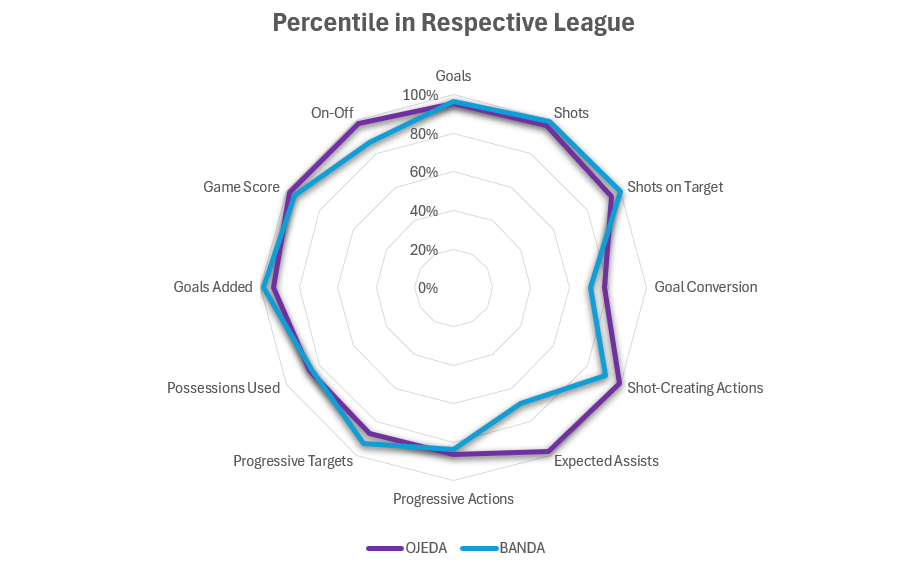
As I am sure you remember from the SAT or ACT or other standardized tests, your percentile score tells you the performance as compared to every other score, so a value of 80% means that the score is better than 80% of all scores. In the radar chart above you can see that in nearly every metric Banda and Ojeda are at least in the 80th percentile or better, and Ojeda was 95% or better in six of 12 while Banda was in five of 12.
I also thought it was interesting that both players basically shared the same shape, other than in expected assists, but then again, when you are among the league’s best in 12 offensive categories, you are going to have a shape that looks an awful lot like a symmetrical dodecagon (fancy word for 12-sided shape), which also looks like the top of a drum, which makes sense, because it is the holiday season, so there are 12 drummers drumming, and I think they are playing me off the stage, so let’s wrap this up.
Ultimately, there is no winner between the two seasons except for us as fans, who were lucky enough to see two great players wearing the uniforms of our favorite teams this year. Banda’s season ended far too soon, and I believe that had she stayed healthy the Pride would have won back-to-back titles. Ojeda set the club record for goal contributions in a single season (you will be able to read more about this next week), and was an MVP and Best XI candidate for most of the season.
It is a lot to ask for both players to put up the same types of per-90-minute numbers next season, but I am hoping that when we get to December 2026 and look back on their years, their performances are comparable to this season.
Vamos Orlando!