Orlando City
Why Three Could Be Greater Than Four In Orlando City’s Back Line
An analysis of MLS teams using three, four, and five-man back lines and whether it would benefit Orlando City to use a three-man grouping going forwards.

Orlando City rolled out a three-man back line during last Sunday night’s game against Columbus, and while that formation alone is not responsible for the Lions leading for most of the game and getting their first point of the season on the road, it definitely played a role. During the Óscar Pareja era, Orlando City nearly always played with a four-man back line, but with a lot of roster turnover from last season and new leadership on the sideline, it could be time to give the three-man group a look, as the Lions try to climb out from the bottom of the standings and make the playoffs for the seventh consecutive season.
We will explore whether a three-man back line is worth pursuing below, but making the playoffs is definitely a five-star idea and highly recommended.
Soccer back lines, and formations in general, are fluid. Baseball is static before every play, so you can see exactly where every fielder (defender) was and evaluate offensive and defensive performances against shifts or alignments. American football is not exactly static, but it is closer to baseball than soccer, with most players being still as the play is initiated. Soccer is most similar to hockey, basketball, and lacrosse, where even though players are nominally playing set positions, those positions can constantly change throughout a play and throughout the entirety of the game.
That said, most players generally play in a specific position for much of the game, so we can look at some tracking data and make generalizations about the formations. Opta’s tracking analysts list a primary formation for each team in every game, and while it is not perfect, it is correct more often than not for the general formation used by that team in that game.
Opta’s tracking on fbref.com gives the following table for every formation used in MLS play so far this year, and I have added the associated points earned, goals scored, and goals allowed by each team while in that formation. Make sure you are taking the formation with somewhere between a grain of salt and the bottom third of the salt shaker, but this is the unedited data:
| Formation | Games Used | Avg. Points Earned | Avg. Goals For | Avg. Goals Allowed |
|---|---|---|---|---|
| 4-2-3-1 | 77 | 1.58 | 1.74 | 1.44 |
| 4-3-3 | 48 | 1.35 | 1.67 | 1.65 |
| 4-4-2 | 32 | 0.97 | 0.84 | 1.41 |
| 3-4-3 | 30 | 1.47 | 1.57 | 1.83 |
| 3-5-2 | 7 | 1.43 | 1.57 | 1.57 |
| 5-4-1 | 4 | 1.25 | 1.25 | 0.75 |
| 4-1-4-1 | 3 | 1.33 | 1.67 | 1.33 |
| 3-4-1-2 | 3 | 1.67 | 2.00 | 1.67 |
| 3-5-1-1 | 1 | 3.00 | 4.00 | 3.00 |
| 4-4-1-1 | 1 | 0.00 | 0.00 | 3.00 |
I think it is probably easier to just bucket the different formations into simpler sets, using the number of defenders to segment the formations:
| Back Line | Games Used | Avg. Points Earned | Avg. Goals For | Avg. Goals Allowed |
|---|---|---|---|---|
| Three-man | 41 | 1.51 | 1.66 | 1.81 |
| Four-man | 161 | 1.38 | 1.53 | 1.50 |
| Five-man | 4 | 1.25 | 1.25 | 0.75 |
Most teams in MLS, and also around the world, utilize four-player back lines. Coaches are pragmatists, and some combination between using a lineup that feels more secure (i.e. usually one with more defenders) and one that will not get ridiculed by players, pundits, fans, owners, and writers (the audacity of someone to analyze and comment on lineup choices, how dare they?) drives a hefty portion of the decision making for those making lineup decisions.
Orlando City used a three-man back line in the game against Columbus, though there were parts of the game when it looked much more like a five-man back line with Griffin Dorsey and Iván Angulo dropped all the way back on defense. The sofascore.com heatmaps for all five (Angulo, David Brekalo, Robin Jansson, Iago, and Dorsey) are listed below in order from left to right, and you can see where all five have a good amount of touches in the defensive third. Angulo and Dorsey played far higher than the middle three, however, which is why the formation Opta assigned to Orlando City was a back three. Imperfect, but directionally it makes sense.

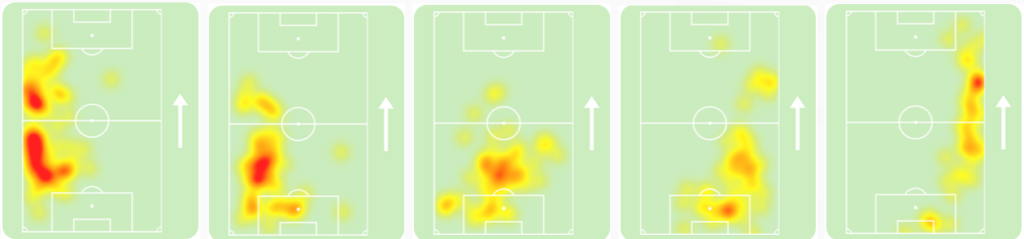
With the players on the current roster, a back three may well be the right lineup to use until the next transfer window. There is a not a lot of blazing speed among Orlando City’s defensive group, but most of the defenders have decent size and are good in the air, so protecting the heart of the defense with Brekalo, Jansson, and Iago as the starters and Adrián Marín and Tahir Reid-Brown as backups gives the team some decent depth without sacrificing size. Alas, this comes one year too late for former Lion Thomas Williams, who probably would have been better suited to a back three than a back four.
In addition to having a good set of center back candidates, Angulo, Dorsey, Zakaria Taifi, and Marín are all good wingback options as well, and players who have the skills and pace to get up into the attack while also recovering back to help out the defensive line.
Orlando City’s current personnel fits the three-man back line well, and considering most teams in MLS are using four-man back lines, that decision also bodes well considering how three-man back lines have done this season when playing against four- or five-man back lines. Three-man back lines have been used against four- or five-man back lines 31 times thus far this season, and those teams are earning 1.58 points per match during those games. That amount of points per match would have been in the top half of MLS last season (13th), right above the actual 2025 Orlando City team, which finished on 1.56 points per match.
Orlando City hosts Houston this weekend, and the Dynamo have primarily used a four-man back line (featuring former Lion Antonio Carlos) thus far this season. On Saturday night we will see if the three-man back line was just for the Columbus game or if it is something that the Lions will trot out again in hopes of continuing the league-wide trend of teams finding success when playing three in the back against teams playing four in the back.
I do not really care whether it is three or four in the back, as long as that by the end of the game Orlando City has done better than Houston at putting more in the back…of the opposition’s net.
Vamos Orlando!