Orlando City
Inside the Numbers: Goal Scoring and Shot Creation for Orlando City, OCB, and the Pride
A comparison among all three Orlando teams on where their goals and chance creation have come from.

Starting next week, all three Orlando teams will be back in season. After playing the most games (15) going into the World Cup break, Orlando City will return having played fewer games than both the Pride (will be at 16 games) and Orlando City B (will be at 19 games). MLS NEXT Pro channeled, fittingly, its inner Junior Senior and said we “won’t stop (won’t stop) won’t stop the beat” and kept playing through the break, hence OCB’s large lead in games played. The Pride returned two weeks ago, and are in the midst of a two-game week to vault them past Orlando City as well.
As of the writing of this article Orlando City had played 15 games, the Pride 14, and OCB 18, and with all teams coming back into action this felt like a good time to have a good time by talking about the most fun part of soccer — creating chances and scoring goals. Goalkeepers might disagree with that statement, but they can take inspiration by what they see when they look left and right on the goal line and pipe down.
The three charts below show every player who has scored at least one goal for any of the three Orlando teams thus far this season, using FotMob’s data for “chances created.” Chances created is FotMob’s category name for the stat also known as key passes (the MLS and MLS NEXT Pro websites track these pretty well, the NWSL’s website not so much), which are classified as the final pass that happened before a player takes a shot.
We’ll start with the Pride, using data through their game against Kansas City on July 10:
| Player | Minutes | Goals | Goal Share | Chances Created* |
|---|---|---|---|---|
| Barbra Banda | 1,017 | 12 | 57% | 1.59 |
| Haley McCutcheon | 1,260 | 2 | 10% | 1.29 |
| Hannah Anderson | 545 | 2 | 10% | 0.17 |
| Marta | 346 | 2 | 10% | 1.30 |
| Cori Dyke | 1,244 | 1 | 5% | 0.14 |
| Jacquie Ovalle | 520 | 1 | 5% | 2.25 |
| Nicole Payne | 249 | 1 | 5% | 0.72 |
*per 90 minutes
Barbra Banda’s production continues to be prodigious. She is currently the only player in league history to play more than 1,000 minutes in a season and average more than one goal per 90 minutes (1.06). Her 12 goals accounts for nearly three out of every five scored by the Pride, and she is the only player in the league with a goal share higher than 50%, which says just as much about the rest of the Pride’s offense as it does Banda. Center back Hannah Anderson ranking in a tie for second among goal scorers is also a little concerning.
On the flip side of that concern, however, is a reminder that Marta and Jacquie Ovalle have not even played a combined 900 minutes. When they play, they create shots — in particular Ovalle, who is in the top 10 in the league in chances created per 90 minutes — and Pride fans can continue to imagine what it would be like to see a front line of Banda, Ovalle, and Marta, and to see how they would all create shots and goals for one another.
Moving from one team with a dominant primary scorer to another, Orlando City is up next:
| Player | Minutes | Goals | Goal Share | Chances Created* |
|---|---|---|---|---|
| Martín Ojeda | 1,313 | 11 | 48% | 1.58 |
| Griffin Dorsey | 951 | 2 | 9% | 0.85 |
| Marco Pašalić | 642 | 2 | 9% | 0.70 |
| Duncan McGuire | 481 | 2 | 9% | 1.12 |
| Tyrese Spicer | 440 | 2 | 9% | 1.43 |
| Tiago | 584 | 1 | 4% | 0.46 |
| Justin Ellis | 534 | 1 | 4% | 1.69 |
| Luis Otávio | 417 | 1 | 4% | 0.22 |
| Ignacio Gómez | 14 | 1 | 4% | 0.00 |
*per 90 minutes
Martín Ojeda’s 48% goal share (it’s actually 47.8%, but I rounded all the goal shares to two digits, which is why that column does not appear to sum to 100%; you can breathe a sigh of relief, the math maths) ranks him just behind the 48.1% of Chicago’s Hugo Cuypers, and those two players are the only two players above 45% in MLS. Orlando City’s pattern looks remarkably similar to the Pride’s, with one player scoring most of the goals and everyone else at two or one. The arrival of Antoine Griezmann and the rumored return of Daryl Dike could, and probably should, change that, but we know that Duncan McGuire will not score any more goals for the Lions and Marco Pašalić is also rumored to be moving on as well, so it likely will be someone else who steps up.
Please someone step up.
When it comes to creating shots, Orlando City does not have a go-to player like Ovalle, but both Justin Ellis and Ojeda are in the top 40 in the league. As will be seen below, Ellis is already an elite creator when playing against players his own age, and in a decent sample of minutes, he has shown he has the talent to compete at the MLS level. The next few weeks will reveal a lot about his ability to continue to contribute, as teams have now had the chance to watch him play in MLS and will have him in their game plans once the season resumes. I think he will continue to excel, especially since in recent weeks he has had a chance to play alongside and learn from Griezmann.
Speaking of Griezmann, Orlando City’s newest Lion created 1.90 chances per 90 minutes in La Liga and 1.86 during Champions League play this past season, so I think it is a safe assumption that Griezmann will immediately create chances at a high level once the season resumes. The big question will be if someone will step up to complement Ojeda as a second scorer. Again, I beg someone to do so.
And now for OCB, a team with plenty of players who have stepped up:
| Player | Minutes | Goals | Goal Share | Chances Created* |
|---|---|---|---|---|
| Pedro Leão | 1,195 | 7 | 19% | 1.51 |
| Harvey Sarajian | 1,118 | 5 | 14% | 2.01 |
| Gustavo Caraballo | 895 | 4 | 11% | 2.41 |
| Justin Ellis | 356 | 3 | 8% | 3.03 |
| Justin Hylton | 398 | 3 | 8% | 1.13 |
| Matthew Belgodere | 847 | 3 | 8% | 2.13 |
| Issah Haruna | 1,171 | 3 | 8% | 1.54 |
| Bernardo Rhein | 1,428 | 2 | 5% | 1.58 |
| Ignacio Gómez | 902 | 2 | 5% | 0.50 |
| Nicolas Lasheras | 259 | 1 | 3% | 0.35 |
| Zakaria Taifi | 254 | 1 | 3% | 0.35 |
| Jacob Ramírez | 218 | 1 | 3% | 0.83 |
| Caleb Trombino | 316 | 1 | 3% | 1.14 |
| Dylan Judelson | 1,030 | 1 | 3% | 0.61 |
*per 90 minutes
The Young Lions do not have a single scorer dominating the chart like the other two Orlando teams, but unlike their fellow teams, they have an abundance of players who have scored more than twice this season. Seven different players have scored three or more times and 14 players have scored at least once. As a team, OCB ranks fourth in the league in goals scored per game. No player accounts for more than 20% of the team’s goals, making OCB difficult to defend.
Another reason the Young Lions are difficult to defend is that so many players are constantly looking to set up their teammates for shots and are skilled enough to be able to do so. Four attacking players have created more than two chances per 90 minutes, including the aforementioned Ellis, during his early season games with OCB, and defender Bernardo Rhein creates more shots than almost everyone on Orlando City and the Pride.
The diversity of OCB’s attack, especially as compared to the senior Lions and the Pride, is on display in the chart below, which shows all of the players who have scored at least one goal in league play and their associated chances created per 90 minutes values. OCB’s players are in yellow, Orlando City’s in purple, and the Pride’s in light blue.

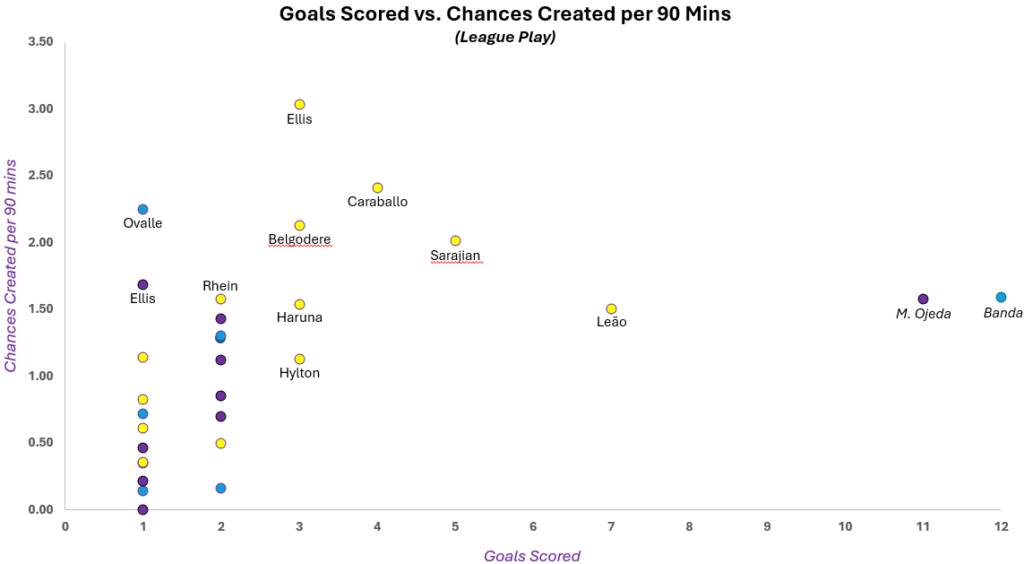
It may be subjective whether you think Florida sits on the Gulf of Mexico or the Gulf of America, but there is also a gulf in Orlando and that is between Banda and Ojeda and the rest of their teammates.
Hopefully, by the time the regular seasons wrap up for all three teams, the gulf is more like a cove, or better yet a stream, as additional scorers have emerged like hot springs for the Lions and the Pride. OCB will be fine if it continues to flood the field with all of its attacking talent. It is the senior teams that need to look deep inside the well to find some additional scorers.
By this time next week, all three seasons will be going again, and with the games coming fast and furious in July and August, we will rapidly see if the second part of the season will look like more of the same, or if that World Cup break will lead to a sea change as the season continues.
Vamos Orlando!