Orlando City B
MLS NEXT Pro Is a Development League and OCB Is Developing Some Winners
A comparison between Orlando City and OCB’s performances this season and a look at OCB’s player development pipeline.

Last week, I wrote about Orlando as a soccer city, and created a ranking system that looked at where the City Beautiful sits among North American cities that have professional soccer teams. Since that article came out, none of the teams that were used as a the basis of the ranking system have played a game, as all of the top teams remain on hiatus due to all of the international games and the final preparations for the FIFA World Cup.
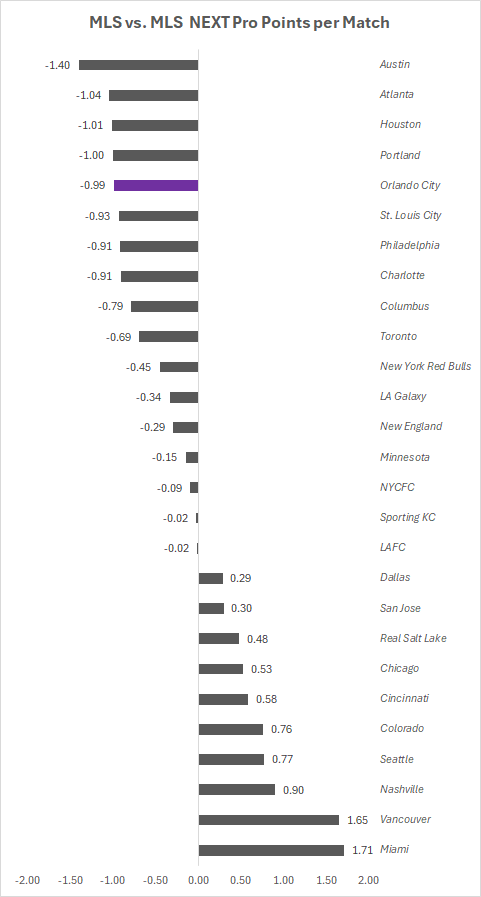
MLS NEXT Pro, however, continues to channel its inner Young Gunz and can’t stop, won’t stop playing regular-season games. As readers of our weekly membership newsletter (you can subscribe here and unlike with FIFA, zero attorneys general have opened investigations about our pricing policies) already know, Orlando City B (OCB) has won four of its last five games and currently sits in fourth place in the Eastern Conference. The Young Lions are averaging 0.99 more points per match than the senior team (1.92 to 0.93), while scoring more and allowing fewer goals per game as well. They are not better players, at least not yet, but they are definitely playing better than Orlando City is relative to their level of competition.
OCB is not the only MLS NEXT Pro team playing much better than its senior team, and considering how poorly Orlando City has performed during MLS play thus far this season, it is not a surprise that the gap between the two in points per match is among the largest for all 27 MLS clubs that have a reserve team in MLS NEXT Pro (D.C., Montreal, and San Diego are the three MLS teams that do not have a team in the lower league). The gap between Orlando teams ranks fifth from the bottom, with only Austin, Atlanta, Houston, and Portland sporting MLS teams with worse points-per-match performances compared to their MLS NEXT pro teams.

On this week’s episode of The Mane Land PawedCast, there was a discussion about how clubs generally view and utilize MLS NEXT Pro, and while the Orlando City front office wants both of its teams to win, what the club really wants to see is player development at the MLS NEXT Pro level and wins and banners at the MLS level. Players who develop well at OCB generally sign Homegrown Player contracts with the senior team, which greatly benefits the team in terms of roster construction because they count differently against the salary cap.
Thus far this season, Orlando City has played five Homegrown Players during MLS games — Justin Ellis, Colin Guske, Javier Otero, Tahir Reid-Brown, and Zakaria Taifi — and their minutes played combine for approximately 10% of Orlando City’s minutes during MLS play. Only Miami and Philadelphia have played more Homegrowns (each has played seven) in games, though 10 teams have played Homegrown Players for a larger share of their minutes than Orlando City’s 10%. The league averages are only 3.1 players and 8.5% of the total minutes, so Orlando City is above average in both.
Of those five Orlando City Homegrowns, only Reid-Brown has played more league minutes with OCB than Orlando City, though by the end of the season it would not be a surprise if that was true for all except for Ellis, as the MLS minutes for the other four dried up during the final games before the World Cup break. A certain Antoine Griezmann will also be joining Orlando City in July and, spoiler alert, he is going to play a lot of minutes, which will push the players at the bottom of the depth chart one rung further away from MLS game time.
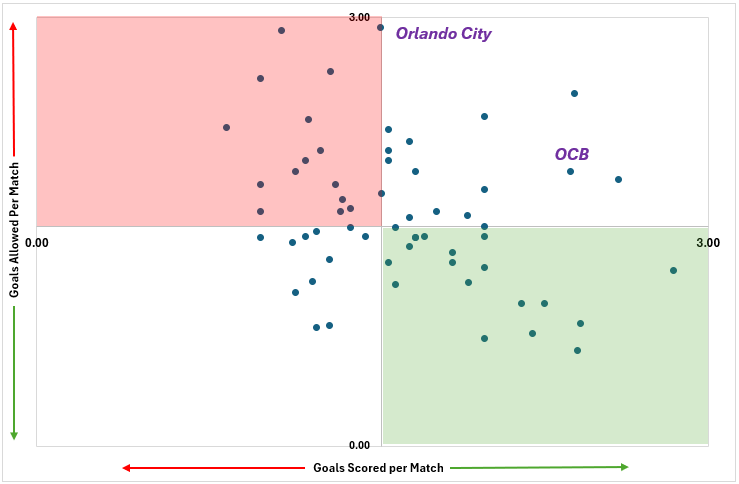
The upshot of this is that OCB is likely to see those Homegrowns dressing and playing in a lot of its games during the back half of the season, making an already strong squad even stronger. If we take a look at all 60 teams between MLS and MLS NEXT Pro, the Young Lions rank sixth in goals scored per game at 2.38, and with a little defensive improvement (like, perhaps, the inclusion of defensive-oriented players Guske, Otero, Reid-Brown, and Taifi in more lineups) they could find themselves in that quadrant of teams that are among the best in both goals scored and goals allowed.

While MLS NEXT Pro teams may not be exclusively focused on Vince Lombardi’s famous quote about winning not being everything, but the only thing, winning is still, like, better than losing (thank you Nuke LaLoosh and Bull Durham), and OCB has been doing a lot of it lately. The club also has five players in the top 89 in FotMob‘s MLS NEXT Pro player rating rankings, including the overall number one Harvey Sarajian, Gustavo Caraballo (12), Pedro Leão (29), Bernardo Rhein (45), and Issah Haruna (89). Sarajian and Haruna are 21 and 22 years old, respectively, but the other three players are all teenagers and are performing at an advanced level in a league where the average player’s age this season is 20.6, according to Transfermarkt.
OCB’s average age across all players is only 18.8, third youngest in the league, so even beyond the top prospects the future continues to look bright for a team full of young players who are already performing at a high level in their league. Hopefully, the gap between their performance and that of Orlando City’s closes when the senior Lions return to play, but only because the MLS club performs more like it did during the last few years instead of how it did during the opening 15 games of MLS play this year. We still have more than a month to go until we will see Orlando City again though, so for now we can just sit back and see how big of a gap OCB can open up, starting with its game Saturday at Huntsville City — a perfect location for some Young Lions to go hunting for another three points.
Vamos Orlando!