
Orlando City B
Orlando City to OCB Loans Explained

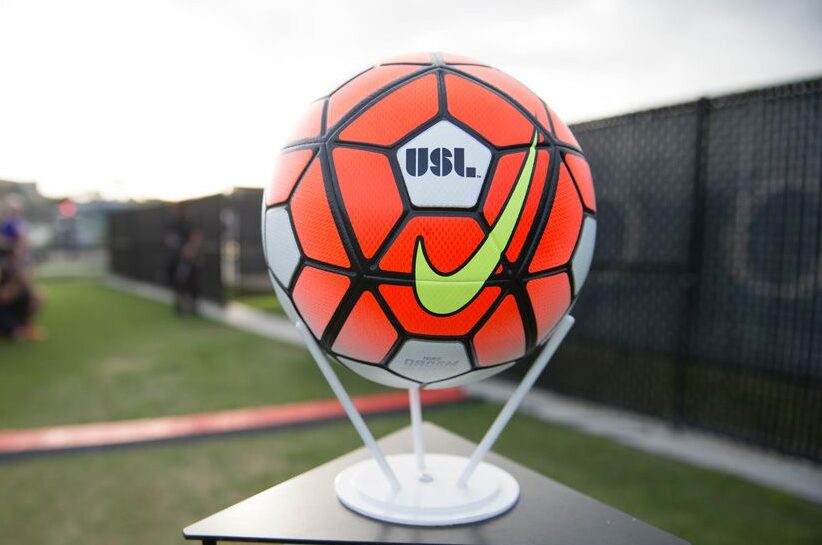
Last July, news broke that Orlando City was planning on launching its own USL team in 2016 that would serve as a de facto reserve squad. The team, made up mainly of young players and senior team players lacking playing time, began its USL season in late March is now are well underway.
While most Orlando City fans likely have a solid understanding of the purpose of Orlando City B, they may not quite understand how players move between teams. With Major League Soccer being a single entity, there are certain aspects, such as the league owning player contracts and the collective bargaining agreement, that make even the simplest move between teams difficult to understand.
The first thing to understand is that while OCB may have the same colors, name, (basic) crest, and be run as the same club as Orlando City, they're not officially the same club. As MLS sees it, Orlando City and OCB are two completely separate entities that just happen to have the same owner. With that in mind, here are the rules that dictate which OCB players Orlando City has control over and how players move between the teams.
Who Does Orlando City Have Control Over?
There are three types of players that Orlando City has control over that play with OCB — Homegrown Players, players on an MLS contract, and USL priority players. A Homegrown Player is a player that has been with an MLS team's academy for a period of one year and has satisfied all training and retention requirements. Even if one of these players signs a USL contract, they are still Homegrown Players when they move to MLS. The only player this applies to now is midfielder Pierre da Silva, who is on a USL contract with OCB but will be a Homegrown Player once he signs with the MLS side.
Any player on an MLS contract, as you would expect, continues to be controlled by the club. These players are officially loaned to OCB. They can be either loaned for a short period of time, such as a game, or for the whole season. However, the length of their loans doesn't necessarily mean that's how long they'll be at OCB. We'll go over that a little later.
The final players the club has control over are USL priority players. Each MLS team can have up to three USL priority players with their USL affiliate. These are players that the club has control over should they move to MLS without having them take up a discovery spot. For the club to have the rights over any additional players, they would take up a spot on the club's discovery list.
MLS-USL Call-Ups
As previously mentioned, Orlando City can't just call up any player from OCB, as the Lions don't have the rights to most of the team's players. However, the league has put some new agreements in place for 2016 where some players that don't satisfy the above criteria could be called up under special circumstances.
MLS has instituted USL short-term agreements in which players can be called up on four-day contracts for specific matches. But there are restrictions to the short-term agreements. The player brought in must be 25 years old or younger and the games can only be for the CONCACAF Champions League, Lamar Hunt U.S. Open Cup, or exhibition matches. One of these situations occurred for Orlando City last year when the team had a friendly against West Bromwich Albion sandwiched between two league matches. The Lions wanted to call in some academy players to give the injury-ridden team some help but were unable to. This year, they could call in some OCB players if that situation occurs again.
Each player from OCB can be called up for four short-term agreements per season. That means that they can spend a total of 16 days on the MLS roster. While these agreements are limited to cup games and exhibitions, the MLS club is allowed to sign short-term agreements for league games only if in "extreme hardship."
Extreme Hardship Call-Ups
This year, MLS has introduced a new situation called "extreme hardship" in which teams can call up players they would typically not be allowed to call up. If Orlando City is going into a game with fewer than 15 players available or no more than one goalkeeper available, the club will be allowed to claim an extreme hardship and call up a player from OCB. In these situations, the rules of the USL short-term agreements apply, so the player would have to be 25 years old or younger. While they're with the team, they will also be eligible to play in cup games or exhibition games.
OCB Loans
Orlando City may loan any player it wants to OCB, with roster relief given but not budget relief. That means that loaning a player from the MLS squad will open up a spot on the roster but that his salary will still count against the team's salary budget. However, one player may be loaned to OCB with roster relief and budget relief (meaning his salary will not count against the MLS team's salary budget), assuming he fits certain criteria. The player must be under the age of 25 and his total compensation must be less than or equal to the MLS Senior Minimum Salary of $62,500. This means the player must be on the team's supplemental roster (spots 21-24) or the reserve roster (spots 25-28). In order for the player to receive full roster and budget relief, the loan must be season-long.
If you've been following the loans from Orlando City to OCB, you may have noticed that some have been for one game and others season-long. But that doesn't mean those loans will actually last that long. If a player is loaned for the season to OCB, they can't be recalled by the MLS team unless the team has a right of recall in the agreement. If the right of recall is in the agreement, there are no restrictions to how many times a player can be loaned or recalled during the season. Every Orlando City loan this year has had the right of recall instituted except for teenage goalkeeper Mason Stajduhar. But the only time Stajduhar would be called up is in the case of extreme hardship. Essentially this means that any player, with the exception of Stajduhar, loaned from Orlando City to OCB can be loaned and recalled at any time and as much as they want.
As usual, MLS has taken a seemingly easy process and managed to make it extremely complicated. Hopefully this guide will give you a better idea of who Orlando City is able to call up from OCB and which players they have control over in the future.







Orlando City B
Orlando City B vs. Atlanta United 2: Final Score 4-2 as OCB Falls Out of Playoffs on Decision Day
OCB tumbled out of the playoff places on the season’s final day, losing badly at home to rival Atlanta.

Orlando City B (11-10-7, 44 points) saw its season come to an end today with a 4-2 loss to Atlanta United 2 (14-9-5, 48 points) at Osceola County Stadium in Kissimmee. Atlanta’s four goals came from Arif Kovac, Ignacio Suarez-Couri, Dominik Chong Qui, and an own goal by Harvey Sarajian that goalkeeper Tristan Himes punched off the forward’s back. Issah Haruna and Justin Hylton were the goal scorers for the Young Lions.
OCB Head Coach Eddie Wiliding deployed the same team that won 4-1 over Inter Miami II on Sept. 4 and 3-1 over Toronto FC II on Sept. 13. Himes started in goal behind a back line of Clovis Archange, Nolan Miller, Landon Okonski, and Parker Amoo-Mensah. Hylton and Ignacio Gomez were the defensive midfielders behind Sarajian, Gustavo Caraballo, and Haruna with Pedro Leao up top.
The Young Lions came into this game needing two points to ensure at least a spot in the play-in round. There were several scenarios that would have seen OCB make the postseason even with a loss, but those required help from the teams behind them. But it was a rough game from the start. The Young Lions conceded shortly after kickoff and, even with an equalizer, it felt like they were chasing the game throughout. Hylton’s goal in first-half stoppage time gave the them some hope, but they didn’t do much in the second half, limping to the season’s end.
It was the worst possible start for the Young Lions with Atlanta scoring less than three minutes after kickoff. Atlanta goalkeeper Jonathan Ransom cleared a long ball up the field that Miller headed out. However, Andrew Jardines beat Gomez to the ball before finding Cameron Dunbar on the left. Kovac got behind Okonski and Miller, tapping the low cross in to give his team the 1-0 lead.
The Young Lions had their first chance in the seventh minute when Sarajian, who played for the first team Saturday night in New England, took a free ball and split two defenders to get into the Atlanta third of the field. The attacker sent the ball centrally for Carballo, who tapped it on for Gomez. The defensive midfielder had space for a shot, but Mohamed Cisset blocked his attempt.
The visitors immediately went the other way, nearly scoring a second. Quick passing resulted in Enzo Dovlo receiving a pass down the right. Dovlo laid the ball back for Jardines, whose cross went through three players before landing at Kovac’s foot in the six-yard box. The striker turned to touch the ball past Himes, but the OCB goalkeeper blocked the attempt to keep the deficit at one.
The Young Lions found an equalizer in the 18th minute when Caraballo passed to Haruna on the right. The midfielder took on Chong Qui one-on-one and, with his defender backpedeling, shocked everyone with a hard shot that beat Ransom to even the game at 1-1.
An Archange giveaway in the 25th minute gave Atlanta a chance to retake the lead. Dovlo took the ball off the left back’s foot and sent a cross to the top of the six-yard box, where Kovac found space between Okonski and Amoo-Mensah. The striker got his head to the ball, sending it into Himes’s arms.
Haruna lost the ball to Chong Qui in the 29th minute, creating another chance for Atlanta. The attacker dribbled to the end line and sent a cross to the near post for Kovac, but Okonski got in front to block it over the end line.
Himes jumped over Miller to punch the ensuing set piece away. However, his punch was too low, hitting Sarajian in the back. It rebounded off Sarajian and into the net for an own goal, giving Atlanta a 2-1 lead.
OCB nearly equalized again off the restart when DD Sibrian tripped Caraballo in the Atlanta third of the field. Caraballo sent his free kick to the far post, where Miller collected it. The center back put his attempt on target, but he couldn’t get much on it, allowing Ransom to make a relatively easy save.
The visitors doubled their advantage in the 40th minute when Dunbar made a strong run to the end line before playing the ball between Amoo-Mensah and Okonski. Suarez-Couri was wide open, with multiple OCB defenders standing around. It was an easy tap-in by Suarez-Couri to give Atlanta a commanding 3-1 lead.
Matthew Senanou tripped Sarajian just beyond midfield in stoppage time, which resulted in a goal for the Young Lions. Caraballo’s free kick to Haruna on the right saw the midfielder dribble inside. He laid the ball off for Hylton before receiving it right back. Hylton made a run and Haruna found him, resulting in a shot from the right side of the box. Chong Qui got in front of the attempt, deflecting it over Ransom to cut the deficit to 3-2.
At halftime, Atlanta had more shots (7-6), shots on target (4-2), crosses (3-1), and corner kicks (3-0). OCB had better passing accuracy (84.5%-72.4%) and trailed by one heading into the final 45 minutes of the regular season.
The Young Lions had the first chance of the second half in the 52nd minute when Amoo-Mensah received a long pass on the right and laid it back for Hylton. The attacker’s second touch was a knuckling shot that Ransom could only block over the end line. Atlanta headed away the ensuing set piece, ending the threat.
Ransom sent a long ball up the left in the 63rd minute, which Amoo-Mensah had in his sights. However, Amoo-Mensah’s attempt to volley away the ball hit off his own arm and deflected behind him, where Chong Qui took control with a path to the OCB goal. Chong Qui took a touch to his left and cut inside to beat a sliding Okonski before nutmegging Himes to make it 4-2.
Atlanta nearly scored again in the 68th minute when Daniel Chica knocked a Santiago Pita corner kick back out to the substitute. On Pita’s second cross to the back post, Himes was off his line and Senanou’s header looked like it might dip just under the crossbar, but Himes got back just in time to tip it over the goal.
Wilding made his first two changes in the 71st minute, replacing Sarajian and Gomez with Matthew Belgodere and Nicolas Lasheras.
Leao received a long ball down the left in the 74th minute, sending the striker behind the back line. The Brazilian dribbled in on Senanou before finding Belgodere just outside the box. The second-half substitute’s shot deflected off of Senanou’s foot, nearly causing it to get past Ransom. But the Atlanta goalkeeper adjusted well to make a one-handed save.
Ransom sent a long ball down the field in the 77th minute, trying to get Kovac in on goal. The striker was behind the back line with Himes off his line and tried to chip the goalkeeper, but he hit the shot too softly, allowing Himes time to get back and make the easy catch.
Wilding made two more changes in the 81st minute as Nicolas Torres and Brady Kendall came on for Okonski and Leao.
Haruna made a strong run into the Atlanta third of the field in the 82nd minute before Chong Qui brought him down. Caraballo sent the ensuing free kick to the back post, where Miller was making a run. The center back got his head to the ball, putting it off the near post.
Wilding made his final change in the 90th minute, looking to keep his team’s season alive. Hector Aguirre entered the contest, replacing Haruna.
The referee showed five minutes of stoppage time with OCB needing two goals. In the second minute, Belgodere sent a ball into the box that Ransom punched away. Caraballo collected it at the top of the box and tried to dribble through multiple players, eventually losing possession.
A minute later, Caraballo dribbled through the defense more successfully, taking a shot from the top of the box. However, his attempt was right at Ransom, who made the easy catch.
The final chance came in the fourth minute of stoppage time. Belgodere lifted a ball into the box and Joshua Kwon failed to clear it. It fell to Kendall, whose first-touch shot was too close to Ransom, allowing the Atlanta goalkeeper to fall on it.
At full time, OCB had more shots (14-10), but Atlanta put more on target (7-6). The hosts also had more crosses (9-4) and better passing accuracy (85.5%-71.6%), while the visitors won more corner kicks (5-4).
Even with a loss, the Young Lions could have made the postseason. But they would have needed Huntsville City FC and Philadelphia Union II to lose. Unfortunately, Huntsville scored twice in the second half to beat New York Red Bulls II, causing OCB to finish the season in 10th place.
After finishing in fifth in 2023 and 2024, OCB has now missed out on the postseason in back-to-back years. This season is even more disappointing. The Young Lions had a great chance to host a playoff game for the first time before slipping into a five-game losing streak. They bounced back by winning three straight and had a great chance to secure a playoff spot but failed at the final hurdle.
That concludes the 2026 OCB season. It will be remembered as a year of missed opportunities and, ultimately, a disappointing campaign. Although OCB continues to successfully develop players for the first team — its primary mission — it continues to lag behind other clubs in terms of team success.
The match also completed a miserable weekend for the club, as all three teams lost, and all three surrendered four times and lost by multiple goals.
Orlando City B
Orlando City B vs. Toronto FC II: Final Score 3-1 as OCB Takes Big Step Toward Playoffs
OCB earns its third straight win, ensuring the Young Lions control their own playoff destiny heading into Decision Day.
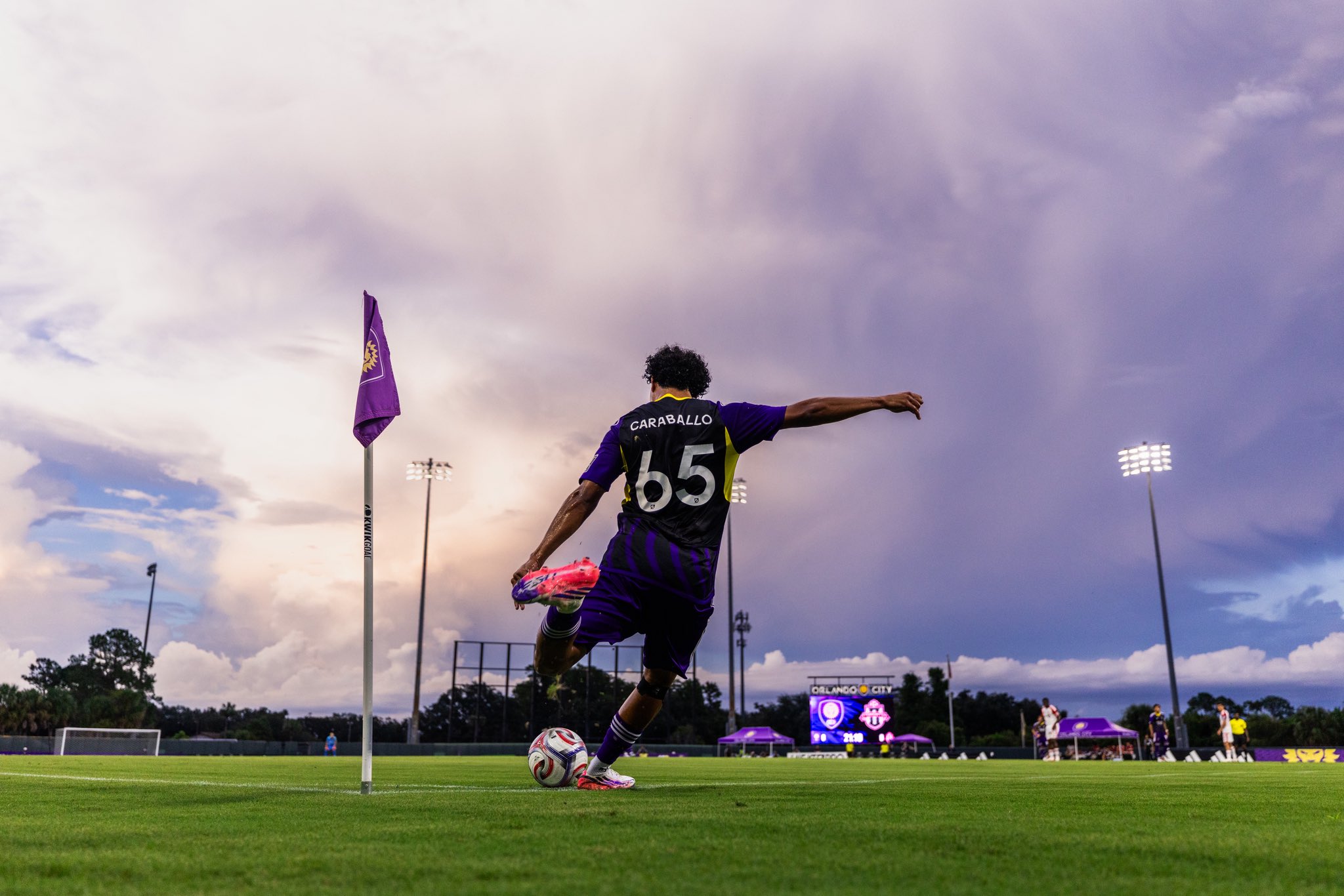
Orlando City B (11-9-7, 44 points) earned a huge three points with a 3-1 win over Toronto FC II (11-12-4, 39 points) tonight at Osceola County Stadium in Kissimmee. Ignacio Gomez and Gustavo Caraballo scored first-half goals before Harvey Sarajian made it 3-0 in the 58th minute. Elias Khodri converted a penalty late, but it wasn’t enough for the visitors.
OCB Head Coach Eddie Wilding deployed the same starting lineup that cruised to a 4-1 win over Inter Miami II on Sept. 4. Tristan Himes was in goal, behind a back line of Clovis Archange, Nolan Miller, Landon Okonski, and Parker Amoo-Mensah. Justin Hylton and Gomez were the defensive midfielders, Caraballo, Sarajian, and Issah Haruna were the attacking midfielders, and Pedro Leao started up top.
The hosts were the better team from the opening whistle and fully deserved the win. They created more chances and better opportunities, taking a commanding lead just before the hour mark. They bunkered down in the final 10 minutes, allowing the visitors to control possession, and it took some good saves from Himes to avoid a nail-biting finish. But they come away with a huge result heading into the last game of the regular season.
The first chances came in the third minute when a poor pass by Amoo-Mensah for Himes went over the end line for a Toronto corner kick. While the visitors couldn’t create anything from the set piece, the eventual cross went just over Reid Fisher’s head. Richard Chukwu collected the ball, and Okonski headed away his cross.
Caraballo broke the other way with Sarajian and Leao. The attacker decided to play the ball to his left for Sarajian, who dribbled into the box and sent his shot just wide of the near post.
Toronto had another good chance in the seventh minute when Chukwu sent a dangerous ball to the back post where Damar Dixon was making a run. Fortunately, Archange reached the ball first, knocking it over the end line. The Young Lions cleared the ensuing corner kick, ending the attack.
Leao intercepted a bad ball out of the back by Toronto goalkeeper Adisa De Rosario. Rather than dribbling into the box, the striker sent an off-target pass toward Sarajian. Fortunately, it was also just beyond Gabriel Mikina’s reach. Caraballo took possession and sent a weak shot that didn’t cause any trouble for De Rosario.
The Young Lions opened the scoring in the 27th minute when Amoo-Mensah found Haruna with space, allowing him to enter the Toronto third of the field. While Leao was calling for a square ball, Haruna played a beautiful pass between a pair of defenders for Gomez’s well-timed run into the box. The midfielder’s second touch was a shot past De Rosario and inside the far post to give OCB the 1-0 lead.
Amoo-Mensah made a run to the end line in the 42nd minute before sending a cross to the back post. Leao had his back to the goal and attempted a bicycle kick, sending his attempt wide.
A minute later, the Young Lions doubled their lead. It started with an innocuous ball from Archange to Caraballo in the OCB half. The attacker dribbled into the Toronto third with no defender stepping up to challenge him. As he approached the top of the box, Caraballo took a touch inside and sent a gorgeous, curling shot past De Rosario and just inside the far post to make it 2-0.
Miller touched the ball off of Salaou’s foot in the third minute of stoppage time and Sarajian broke the other way. Caraballo sprinted down the field to provide support and Sarajian sent him into the Toronto box. The attacker opened up and attempted to curl the ball around De Rosario, but the goalkeeper got down to make a terrific save. However, Sarajian waited too long to make the final pass, causing Caraballo to be offside, so it wouldn’t have counted had it gone in.
It was a good first half by the hosts, who held the advantage in shots (7-2), shots on target (3-0), and passing accuracy (90.4%-90.1%). Toronto had more crosses (3-2) and corner kicks (4-1) in the first 45 minutes.
OCB had a great chance for a third in the 48th minute when Himes threw the ball long for Sarajian. The Young Lions had a two-on-one break with Leao to Sarajian’s right. However, as the defender closed him down, Sarajian tried to take it himself, lost possession, and ended up being called for a foul.
A minute later, Sarajian had the ball in the Toronto box with more defenders. This time, the attacker played it square for Caraballo, whose first touch sent it further right for Haruna. The midfielder settled and shot, but his attempt was deflected off target.
Toronto had a golden chance to get one back in the 54th minute when Marko Stojadinovic played Bryce Boneau in the OCB third of the field. Boneau’s first touch was a lovely pass for Jahmarie Nolan behind the back line. But, as the attacker prepared to open up for a shot, he tripped, softly touching the ball into Himes’ arms.
The Young Lions nearly scored a third in the 57th minute when Amoo-Mensah sent a fantastic cross beyond the far post. It was just over Dixon’s head where Okonski was waiting for it. The center back headed the ball toward the back post, forcing De Rosario to dive to his right to make a one-handed save.
Toronto quickly went the other way, losing the ball in the OCB third and allowing the Young Lions to build a counterattack. A give-and-go between Haruna and Gomez gave Haruna space to play the ball to Sarajian on the left. Stojadinovic was in a good defensive position, but Sarajian used his change of pace to create space for a shot, placing a left-footed shot from the left behind De Rosario and inside the right post to make it 3-0.
The goal seemed to spark Toronto as the Reds attempted to get back into the game to avoid being eliminated from playoff contention with one match remaining. In the 61st minute, Lucas Dawson dribbled through several OCB defenders before it was tapped off his foot. The ball went directly to Nolan at the top of the box, but his shot was over the target.
A minute later, Boneau winded through the OCB defense before playing the ball wide left for Fletcher Bank. Dixon came in from the right and tried to direct the ball on target but sent it over the crossbar. Bank created a chance for himself in the 65th minute, dribbling strongly down the left. The attacker had a step on Amoo-Mensah and found space for a shot, but he sent the attempt off target.
Wilding made his first substitution in the 66th minute, replacing Caraballo with Matthew Belgodere.
Stojadinovic received a pass from Boneau just inside the OCB half of the field in the 73rd minute and made a long run to the top of the box. The defender took a hard shot that Himes could only block wide. Toronto kept possession, eventually creating a cross for Dixon with nobody near him. The attacker’s first touch was a poor one, taking him inside and allowing Himes to close him down. By the time he was able to shoot, Himes was in an excellent position to make the save.
Wilding made two more changes during the 77th-minute hydration break. Brady Kendall and Nicolas Lasheras came on for Sarajian and Leao.
Kendall attempted to make his presence apparent in the 80th minute after receiving a pass from Haruna near the top of the Toronto box. The substitute took a touch before unleashing a right-footed shot that skipped wide of the target.
De Rosario tried to make something happen in the attack off the restart, sending a long ball into the OCB box. Dekwon Barrow had space and was behind the back line, but he couldn’t get enough on his header, allowing Himes to make the stop.
Toronto got a lifeline in the 83rd minute when Salaou found Fisher near the top of the OCB box. Belgodere challenged the center back, popping the ball up and towards the end line. It was a race bewteen Himes and Barrow to reach the ball with the Toronto attacker getting there first. As a result, Himes bundled him over from behind and referee Russell Miller pointed to the spot.
Khodri stepped up to take the spot kick. He sent Himes the wrong way, tucking the ball into the corner to make it 3-1.
In the 86th minute, a cross into the box went off Lasheras’ head, giving Toronto a great chance for a second. The deflection sent it over a group of players to Barrow and Khodri at the top of the six-yard box. Khodri was the one to get his head on the ball, sending his attempt over the crossbar.
Wilding made his two final changes in the 89th minute. Nicolas Torres and Caleb Trombino entered the contest, replacing Hylton and Haruna.
A poor touch by Kendall after receiving a pass from Archange in the 89th minute resulted in Stojadinovic taking possession. The defender carried the ball into the OCB third before firing from long distance right into Himes’ hands.
OCB put everyone behind the ball as the Young Lions tried to hold onto the two-goal lead. While Toronto controlled possession in the opposing half, the visitors couldn’t create any more shots, allowing the Young Lions to come away with the 3-1 win.
At full time, both teams had taken 14 shots and Toronto put one more on target (6-5). The visitors also attempted more crosses (12-5), won more corner kicks (6-3), and had better passing accuracy (88-7%-84.4%). But most of that was after OCB had a three-goal lead.
The Young Lions were struggling heading into the business end of the season. However, they responded from a five-game losing streak by winning their last three and putting themselves in a great spot to make the postseason.
The win puts OCB in eighth place on 44 points with every team having one game remaining. The Young Lions are only two points behind New England Revolution II for third and three points ahead of Huntsville City FC for 11th. As a result, they could finish anywhere from third to 11th, depending on what happens in the final game of the season.
That game will take place Sept. 20 at 2 p.m. when OCB hosts Atlanta United 2 at Oscoela County Stadium.
Orlando City B
Orlando City B vs. Inter Miami II: Final Score 4-1 as OCB Claims Three Huge Points in South Florida
OCB took a huge step towards qualifying for the playoffs with a road win over Inter Miami II.
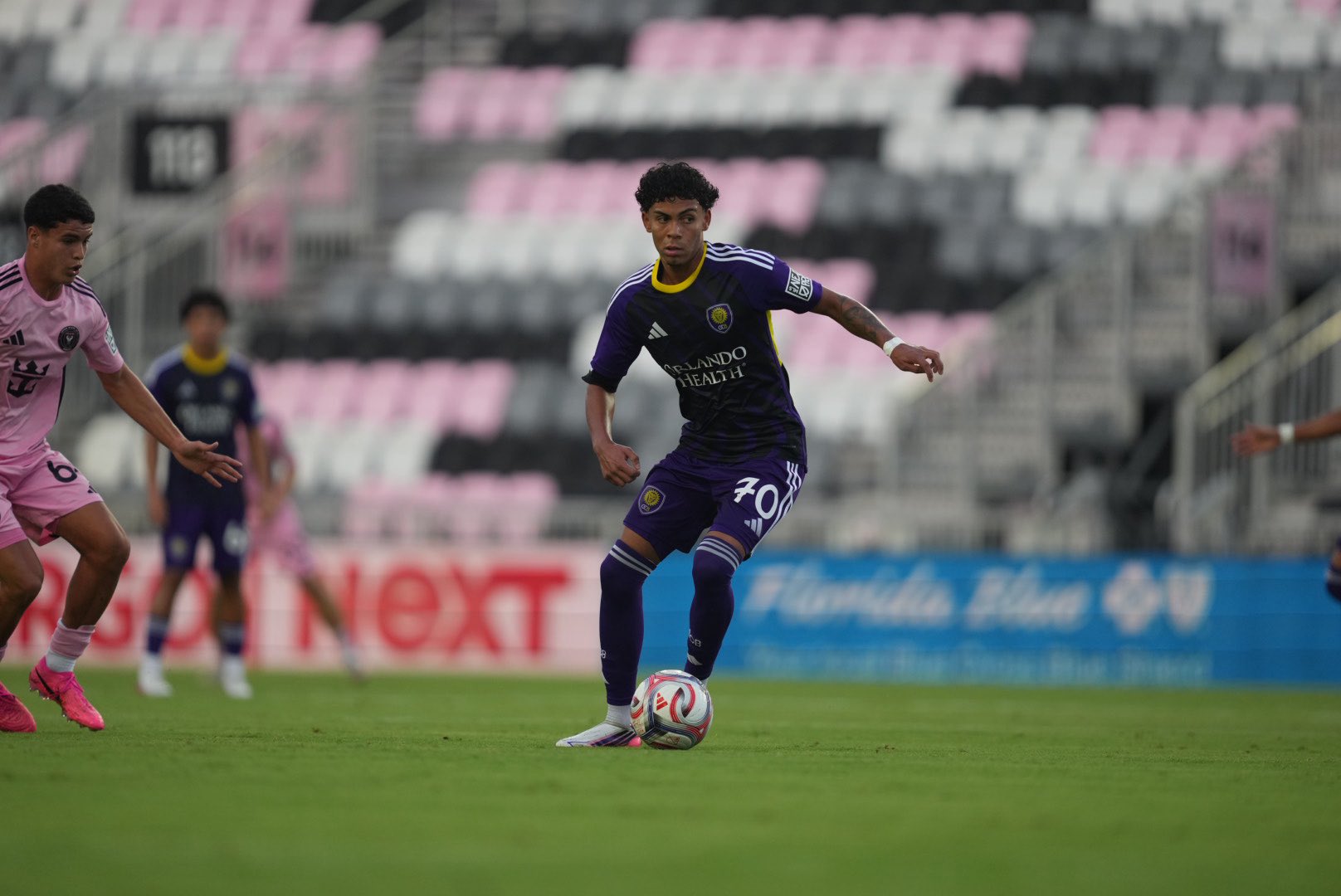
Orlando City B (10-9-7, 41 points) controlled in-state rival Inter Miami II (3-18-5, 15 points) tonight, winning 4-1 at Chase Stadium in Fort Lauderdale. Issah Haruna, Harvey Sarajian, Gustavo Caraballo, and Ignacio Gomez were the OCB goal scorers, while Nash Dearmin scored the lone goal for the South Florida club.
OCB Head Coach Eddie Wilding made one change to the team that beat Crown Legacy FC 3-2 Sunday night. Sarajian entered the starting lineup in place of Matthew Belgodere, who started on the bench.
Goalkeeper Tristan Himes started behind a back line of Clovis Archange, Nolan Miller, Landon Okonski, and Parker Amoo-Mensah. Justin Hylton and Gomez were in the defensive midfield behind Caraballo, Haruna, and Sarajian with Pedro Leao up top.
This was a much bigger game for OCB as the Young Lions fight for a playoff spot and Miami is already eliminated. That difference showed as the visitors were the more aggressive team and looked more determined to come away with three points. Miami created more shots than its opposition, but most of those attempts were from long range and well off target or blocked. Meanwhile, OCB had the better opportunities with a much higher percentage of shots on target.
The hosts created the first shot in the sixth minute when Nicholas Almeida intercepted a Sarajian pass and sent Idoh Zeltzer-Zubida forward. The attacker got behind the back line and it appeared as though he would be in on goal. But Okonski and Amoo-Mensah caught up. Amoo-Mensah deflected Zeltzer-Zubida’s shot from outside the box off target, and the Young Lions cleared the ensuing set piece.
OCB’s first chance came in the 10th minute and resulted in the game’s first goal. It started when Miller lifted the ball long on the right for Haruna. The attacker dribbled inside, used a spin to create space from his defender, and beat Matias Marin to his near post to give the Young Lions the early 1-0 lead.
It was Haruna’s third consecutive game with a goal after finding the net against Atlanta United 2 on Aug. 22 and Crown Legacy FC on Aug. 30.
Unfortunately, it didn’t take long for Miami to respond. In the 12th minute, Marin sent a long ball down the right for Theo Vorenkamp. The right back cut back to create space from Archange and lifted a cross into the box for Mateo Saja. The attacker chested the ball down, but it was too far in front of him and Okonski sent it away.
The ball landed Dearmin’s feet. He took a couple of dribbles toward the center of the field before beating Himes to his right post to even the game at 1-1.
The Herons thought they’d taken the lead in the 15th minute when Zeltzer-Zubida sent a nice ball behind the back line for Saja. The attacker dribbled into the box and chipped Himes. However, the assistant referee correctly ruled Saja offside.
Miami forced Himes into his first quality save in the 19th minute when Matteo De Paula played Diego Rey to the end line. Okonski had a chance to clear the cross, but the center back couldn’t get a piece of the ball. It landed at Dearmin’s feet, but Himes tipped his shot over the crossbar. OCB cleared the ensuing corner, ending the threat.
Okonski headed away a set piece in the 22nd minute and a poor touch by Sloan Morrison gave OCB a two-on-one. Haruna drove down the field with Caraballo to his right. As Vorenkamp closed Haruna down, the midfielder played Caraballo into the box. Unfortunately, Caraballo’s shot was too close to Marin, allowing the goalkeeper to push the ball wide.
Four minutes later, the Young Lions took their second lead of the game. Amoo-Mensah gave the ball away in his own half, but a bad touch by Vorenkamp allowed Archange to retake possession. The left back played a beautiful ball between two defenders for Sarajian, making a run into the Miami third of the field. The attacker placed the ball behind Marin and inside the far post to give OCB a 2-1 lead.
Miami nearly responded right away, just as it did earlier. Vorenkamp laid the ball off for Rey, approaching the top of the OCB box. The attacker’s first touch was a shot past Himes and off the far post. The rebound set Saja up perfectly with a completely empty goal, but he couldn’t get over the ball, sending it over the crossbar.
Amoo-Mensah sent a long ball forward for Sarajian in the 32nd minute, giving the attacker a good opportunity for his second goal. Vorenkamp caught up, forcing Sarajian to use a nifty touch to create space for a shot. However, Marin had his near post covered and blocked the attempt over the end line.
The ensuing set piece by Amoo-Mensah found Gomez at the far post. The midfielder’s initial header was blocked, but it fell right back to him. Marin blocked his second shot to the near post and the goalkeeper fell on the ball, ending the attack.
The hosts looked to even the game again in the 36th minute when Joseph Convers played a give-and-go with De Paula, setting Convers up just outside the OCB box. However, his first touch from the return pass was a shot that went right at Himes. Seconds later, Rey took the ball off of Miller’s foot and dribbled down the end line. He had a teammate trying to find space, but Archange and Okonski filled in that space, forcing Rey to fire a shot wide of the near post.
Leao broke down the middle in the 43rd minute, playing the ball to his right for Caraballo. The midfielder was unable to create a shot, causing him to look for Gomez instead. His pass was deflected, going to Hylton, who immediately found Leao. The striker quickly took a shot that forced Marin to tip it wide.
Less than a minute later, the Young Lions extended their lead. It started with Archange’s throw-in to Sarajian down the left. The attacker’s long cross through the box was controlled nicely by Haruna, laying the ball back for Caraballo. Gomez turned his back in the box as Caraballo fired from distance. In a bit of luck, the ball bounced off Gomez, redirecting past Marin and in to give OCB the 3-1 lead.
In the dying seconds of the first half, Leao played Haruna behind the back line. It looked like the midfielder might have a free shot on goal, but Vorenkamp slid in to deflect the attempt over the crossbar at the last second. The referee called a foul on the ensuing corner kick, ending the attack and the half.
Both teams took 10 shots in the first half, but OCB put more on target (7-3). While the Young Lions won more corner kicks (4-3) in the first 45 minutes, Miami had better passing accuracy (82.4%-75.3%).
OCB started the second half on the attack, just as it had ended the first. The Young Lions created a shot less than a minute after the restart as Sarajian found Caraballo near the penalty spot. But the attacker’s first-touch shot was over the target.
Miami’s first chance of the half came in the 48th minute when Dearmin played a lovely ball behind the back line for Rey. Himes did well to react quickly, coming off his line and blocking Rey’s attempt to chip him.
While both teams scored early in the first half, most of the early second-half shots were from outside the box and blocked. Miami put a chance on frame in the 57th minute when Saja lifted the ball from the left to the back post. Rey got his head to the ball but put his attempt into Himes’s chest.
Wilding made his first change in the 66th minute, replacing Leao with Belgodere. The substitute took his place on the left side and Sarajian moved into the striker role.
Gomez intercepted and cleared a Jerremy Ortela cross in the 74th minute, but Caraballo immediately lost possession to De Paula. Rather than looking for a teammate, De Paula took a long-distance shot from outside the box, sending his attempt into Himes’s arms.
De Paula received a pass on the left in the 76th minute, lifting a cross to the back post. Vorenkamp was there to get his head on the ball, sending his attempt wide of the near post. It was fortunate for OCB, as Vorenkamp had more time than he realized.
Wilding made two more changes in the 77th minute. Caraballo and Archange exited the contest, replaced by Nicholas Lasheras and Titus Sandy, Jr.
Sarajian played the ball to Belgodere on the left in the 81st minute and the midifeilder dribbled inside before finding Hylton near the penalty spot. Hylton spun to beat Morrison, who stuck his leg in, causing Hylton to go to the ground. Referee Jack Joyce pointed to the spot without hesitation, giving the Young Lions a golden opportunity to score a fourth.
With regular penalty takers Leao and Caraballo having departed, Gomez stepped up to take the kick. The young attacker did well with his first penalty of the season, sending Marin the wrong way to give OCB a commanding 4-1 lead.
Wilding made his final two changes in the 84th minute as Brady Kendall and Caleb Trombino came on for Haruna and Hylton.
Shortly after the changes, Miller fouled Judeson Aldeclat just outside the OCB box, giving the hosts a chance to get a goal back. Alejandro Flores took the set piece, sending his attempt just wide of the near post.
With the result no longer in question, the final minutes were more of a formality. A long-distance attempt by Flores that caused Himes little concern was the only shot by either team as the game slowly approached the final whistle.
At full time, Miami had more shots (22-16), but both teams put eight attempts on target. Despite Miami also winning more corner kicks (8-5), attempting more crosses (11-3), and having better passing accuracy (84.8%-73.8%), OCB came away with a relatively stress-free win.
The three points put OCB in a much stronger position to qualify for the playoffs. The Young Lions currently occupy the eighth position, which would host the No. 9 team in a one-game play-in game. They’re one point behind Atlanta United 2 and two ahead of NYCFC II. While both have a game in hand on the Young Lions, OCB and Atlanta will end the season against each other at Osceola County Stadium.
But that’s not all. OCB is only two points behind New England Revolution II and Connecticut United FC for the fifth and sixth spots. As a result, one of several results — combined with a pair of OCB wins — will see the Young Lions qualify for the postseason.
OCB will likely have to win both of its last two games to make the postseason. That starts on Sept. 13 when the Young Lions host Toronto FC II in their penultimate game of the regular season.


Orlando City B vs. Atlanta United 2: Final Score 4-2 as OCB Falls Out of Playoffs on Decision Day

Orlando City vs. New England Revolution: Five Takeaways

Orlando City vs. New England Revolution: Final Score 4-2 as Lions Cough Up Two Goals Late in Loss

Orlando City vs. Columbus Crew, U.S. Open Cup: Preview, How to Watch, TV Info, Live Stream, Lineups, Match Thread, and More

Lion Links: 9/16/26

Orlando City vs. Columbus Crew, U.S. Open Cup: Final Score 2-1 as Orlando City’s Cup Run Ends


-
 Orlando City2 weeks ago
Orlando City vs. San Diego FC: Five Takeaways
-
 Orlando Pride2 weeks ago
Orlando Pride vs. Houston Dash: Preview, How to Watch, TV Info, Live Stream, Lineups, Match Thread, and More
-
 Orlando City5 days ago
Orlando City vs. Columbus Crew, U.S. Open Cup: Preview, How to Watch, TV Info, Live Stream, Lineups, Match Thread, and More
-

 Orlando Pride2 weeks ago
Orlando Pride vs Houston Dash: Final Score 3-1 as Yolanda Thomas Wins Her First Game in Charge
-
 Orlando City2 weeks ago
Orlando City vs. Atlanta United: Preview, How to Watch, TV Info, Live Stream, Lineups, Match Thread, and More
-

 Orlando City2 weeks ago
Orlando City vs Atlanta United: Final Score 3-2 as Lions Secure First Win in Atlanta Since 2023
-

 Orlando City1 week ago
Orlando City vs. Toronto FC: Preview, How to Watch, TV Info, Live Stream, Lineups, Match Thread, and More
-

 Orlando City1 week ago
Orlando City vs. Toronto FC: Final Score 3-0 as Lions Keep Rolling