
Orlando Pride
Orlando Pride vs. Kansas City Current: A Tactical Deep Dive
How two of the NWSL’s best teams stymied each other en route to a critical draw.

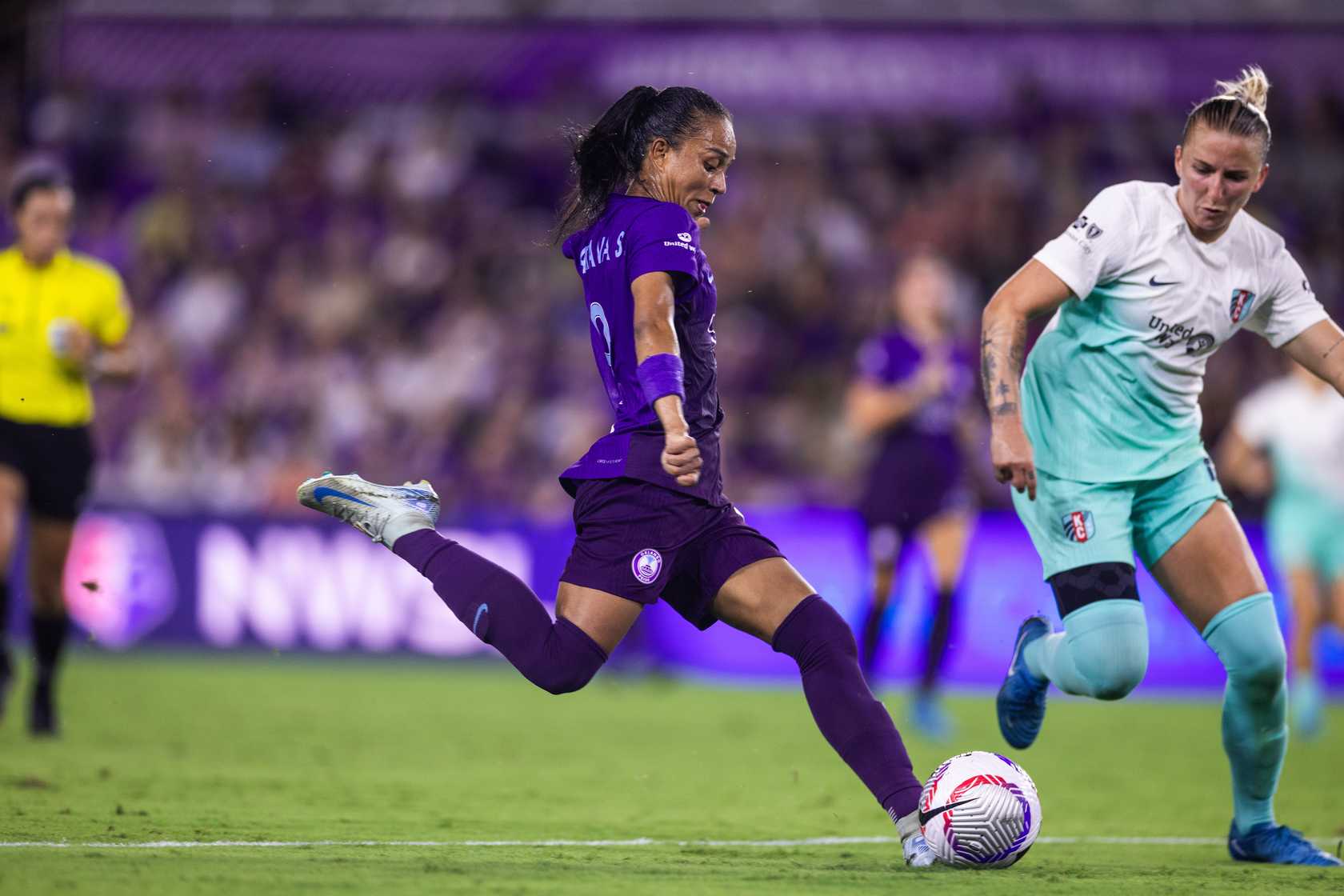
Friday night, nearly 10,000 fans packed Inter&Co Stadium to watch the much-anticipated rematch of two of the top teams in the NWSL. After a red card, a road win, and exuberant celebrations by the Orlando Pride at the Kansas City Current, the latter hoped for revenge in Orlando. Instead, the match played out more like a finely balanced chess match before the points were shared.
So, just how did a match featuring the two golden boot leaders in the NWSL, sitting on a combined 27 goals, end scoreless?
Slowing the Current
As it had been for most of the previous 19 matches of the season, defense was the star of the show for Orlando once again. This had to be the case for Orlando, considering the firepower Kansas City has on its roster. Below are the up-to-date goal contribution tallies for the Current, showing just how many players can hurt the opposition. Despite the potency of the Kansas City attack, the Pride were able to extend their clean sheet streak to four consecutive matches, with only one goal against in the past eight games, which was scored by the Current in Kansas City.
| Player | Goals | Assists |
| Temwa Chawinga | 15 | 6 |
| Bia Zaneratto | 5 | 4 |
| Lo’eau LaBonta | 5 | 1 |
| Vanessa DiBernardo | 4 | 5 |
| Debinha | 1 | 4 |
While Temwa Chawinga would have been top of mind for Orlando’s coaches while preparing for this matchup, they designed a comprehensive game plan for limiting the opportunities of the NWSL’s most potent attack that included all 11 positions on the pitch.
As Player of the Match Cori Dyke put it, “She’s obviously a player that demands a lot of respect. [She is] a really talented player. We did a lot of preparation this week, watched a lot of film, and went through a lot of defensive strategies.”
First among these defensive strategies was the high press that Head Coach Seb Hines employs against many opponents. Against the Current, the Pride began each defensive sequence from the front, engaging the Kansas City back line in a 4-2-4 pressing structure. In this formation, Summer Yates, Barbra Banda, Marta, and Adriana were each responsible for covering a counterpart in the opposition back line, limiting their options for easy passes. Then, when a defender played a ball back towards the keeper, Marta or Banda would trigger a more aggressive press and attempt to close down the ball and generate turnovers.
This high-press strategy often disrupted the flow of the game for Kansas City, but it can be a high-risk, high-reward strategy. If the Pride forced the Current to turn the ball over near their goal, it would create a dangerous chance for Orlando. On the other hand, if the press was unsuccessful, Kansas City could have numerical advantages on the other end of the pitch.
When Kansas City was able to play out from the back and around the Orlando press, the Current more often than not played it towards Chawinga on their left wing to drive towards the Orlando goal. In this match, she received the ball and carried it forward more often than an average match for her, but this is where the Pride had another strategy for limiting her chances. To slow Chawinga, they used Dyke as the primary defender, tasked with marking the golden boot pace-setter closely and had Emily Sams as secondary cover.
Dyke’s job was to push tight to Chawinga when she received the ball, enough to slow her down and give additional defenders time to engage. For Sams, the job was to cheat several yards back towards her own net when the Current possessed the ball, so as to not get beaten by Chawinga’s pace. When the ball did reach Chawinga, Sams would rush to double-team Chawinga and force the turnover or get the ball away from the Current’s most dangerous player. This tactic ensured that while Chawinga could not be completely prevented from influencing the play, it would be difficult for her to keep an attack headed towards Anna Moorhouse’s net.
The last key defensive tactic for the Pride in this match had just as much to do with Kansas City’s lack of endeavor as it did the Pride’s play. Kansas City knew coming into the match that it would be difficult to get a result in Orlando, so the visitors did not attack with the same conviction as they’ve become known for, instead focusing on transition and counterattacks to generate chances without opening the match up for the Pride to do the same.
Because of Kansas City’s offensive setup, the Pride were able to keep much of the game inside the Current’s half. With the distances reduced, the Pride front line and midfield were able to cover more players and passing lanes. So, when the Current progressed the ball initially, they were quickly covered again by an onrushing Angelina, Marta, or Banda, making life more difficult.
While Chawinga was able to create some threat for the Current — to the tune of five shots with two on target — the rest of the Kansas City squad only managed one shot on target. Vanessa DiBernardo, Lo’eau LaBonta, and Debinha all ended the match well below their season averages for shots, touches, and take-ons, a statistic showing how many times a player attempts to beat the opposition off the dribble. Beyond that, Kansas City only generated two corner kicks and four free kicks, resulting in minimal opportunities to commit bodies forward and create more than half chances. As the match progressed, it often seemed Kansas City wouldn’t be too bothered to play out a scoreless draw.
Pride Attack Stifled
Despite the fact that Orlando and Kansas City met as recently as July, a lot has changed in defense for the Current. Since that match, they have added center backs Alana Cook and Kayla Sharples and goalkeeper Almath Schult. These acquisitions were made to shore up several positions of weakness with an eye towards the NWSL championship. In just their second match as a new defensive unit, they played well, limiting Orlando’s chances. The Pride attack has experienced a bit of a drought in recent weeks, as analyzed by The Mane Land’s Andrew DeSalvo in a recent article. So, it is worth looking at what the Current did to stifle the Pride, and how the Pride could have found a way to win the match.
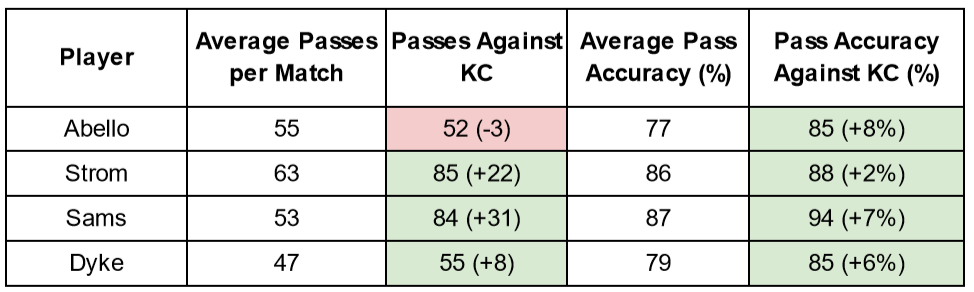
The Current’s defensive game plan against Orlando was simple, but it was effective. For the full 90 minutes of the match, when the Pride possessed the ball, the Current played a high defensive line and didn’t press the Orlando defenders, trying instead to create a congested middle of the pitch. This can be seen in the passing numbers for the Pride defenders, which were well above average in both number and accuracy of passes since there was absolutely no pressure on these players from the opposition.
On the other end of the pitch, Kansas City doubled up against Banda, with the goal of taking her influence out of the game. As a result, Banda had arguably her quietest night in a Pride jersey so far. On average, the Pride are able to find a pass to Banda 22 times per 90 minutes. Against Kansas City, this number was down to just 14 times. When Banda did receive a pass, she was hounded by defenders and unable to progress the ball into dangerous areas. While she averages an astounding six progressive carries per match, she only completed two against the Current. Without the ball, and unable to progress it into dangerous areas, Banda only took three shots versus her usual 5.5, and one was a speculative long-range effort that could’ve been better as a pass to Adriana.
In response to Kansas City’s defensive setup, the opportunities for Orlando came from the wide areas of the pitch. Because of the attention paid to clogging up the middle and double-teaming Banda, Orlando created many one-on-one matchups for Adriana against the opponent. Unfortunately, Hailie Mace defended superbly from the left back position and Adriana could not get anything going. While Adriana possessed the ball roughly twice as much as Banda, she was unable to create opportunities to score. She attempted eight take-ons against Mace, but beat her once, and by the end of the match she had only managed one shot on target and was largely ineffective.
On the other wing, Yates did not have much more success, despite receiving the ball about as many times as Adriana in only 59 minutes. Off the left wing, she similarly only beat her opponent once out of five attempts. Yates was replaced by Evelina Duljan without registering a shot. Duljan, for her part, was quite lively after her introduction. In her 31 minutes, she was able to beat her opponent three times in one-on-one situations, and her progressive carries led to several dangerous situations for the attack in the closing minutes.
In addition to Duljan, the other offensive standout for the Pride was Marta. Of all Orlando’s players, she looked the most likely to create the chance that would’ve won the game. Despite the Current’s tactic of compressing the pitch and clogging the middle, Marta’s movement off the ball and exceptional footwork meant she was able to find pockets of space to receive a pass, turn out of trouble, and transition into attack. As a result, Marta received 51 passes in the match, more than double the next highest tally from front-line players, often because she dropped deep to receive. From there, her 43 completed passes also doubled the tally of any other attacker. Each of the two times she took on a defender, she was able to beat them. Finally, Marta accounted for three of Orlando’s five shots on target, all of which were taken outside the box and required diving saves from Schult.
In the end, Hines said it best, “Kansas were a tough nut to crack at times. You know, they got a lot of bodies behind the ball. They made it very difficult for us to try and create anything. I also think there was quite some good opportunities to score as well.”
Missed Opportunities
As Hines said, despite the solid defending by the opposition, there were a few ways that the Pride weren’t as effective in their attacking play as the coaching staff has come to expect. Some of these missed opportunities were mentioned above, like the wingers not winning their individual matchups against the opposing defense. Another way the Pride could have created chances for themselves, but didn’t, was the high pressing discussed above. While the Current showed a solid game plan for preventing chances when Orlando built from the back, turnovers created in the defensive third can shred a game plan and yield scoring chances. Unfortunately, Orlando was not able to generate a killer turnover in this match.
Another missed opportunity was the lack of threat from set plays. Orlando generated many set pieces, including eight corners and 11 free kicks in total, but these also did not yield a goal. Many times, corners were lofted into an area where the keeper was always favored to reach the ball. Better delivery could have seen a winning goal from Banda, who is already the all-time leader in headed goals for the Pride. Other times, the ball just did not bounce the right way for a rebound. A few of the chances that did come from these set plays fell to Haley McCutcheon, but the defensive midfielder was not able to put any of her four shots on frame.
Holding a talented opponent scoreless is always an accomplishment that requires a good plan, good execution, and sometimes a bit of luck. Fans in Inter&Co stadium didn’t get to see a goal, but they did see interesting tactics and great defense. While this may be biased towards the team in purple, the Pride generally seemed the more likely to come out victorious in this matchup as they had more possession, shots, shots on target, and set-piece opportunities than the opposing Kansas City Current.
At the end of the day, the points were split, and this too may lean in the favor of the Pride. For the Current, one point meant falling behind Gotham in the standings. They may also be running out of time to catch back up to the NWSL shield leaders after leading the league for much of the first half of the season. For Orlando, a point means a continuing undefeated run that now stretches to 21 matches. However, after the Spirit defeated the Houston Dash, Orlando’s lead at the top of the table now sits at four points, and a match between the top two teams is just a few weeks away.




Orlando Pride
World Cup Break Offers Orlando Pride Chance to Stabilize Rebuilt Back Line
After a season of injuries, position shifts, and defensive reshuffling, the Pride have a chance to settle their back line.

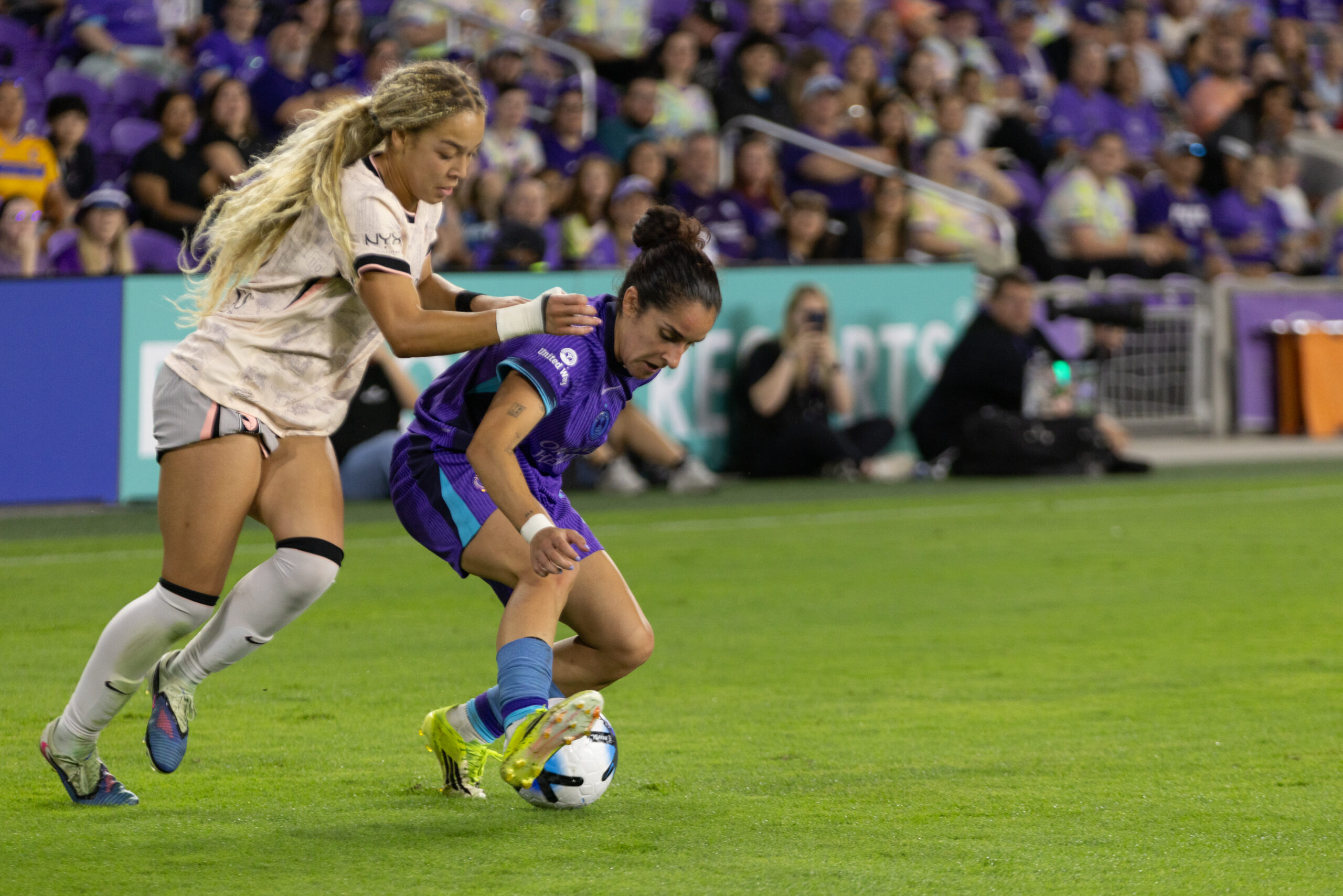
Seb Hines has spent much of the 2026 NWSL season rebuilding the Orlando Pride back line. The FIFA World Cup break now provides the first extended opportunity for the team to settle a defensive unit that has undergone significant personnel and positional changes.
Defense has been one of the team’s defining strengths in recent seasons. The Pride built much of their success on consistency at the back with a settled group of players who understood their roles and rarely needed adjustments. This year, however, that stability has been tested.
The departure of center back Emily Sams, Kylie Nadaner’s pregnancy, and an early-season injury to Kerry Abello forced Hines into changes before the team had the chance to establish continuity. Rather than working from a fixed defensive base, the team has been forced to adjust.
At the start of the season, Hines paired Rafaelle with Hailie Mace in central defense. Mace has experience at center back from her time in Kansas City, but the position isn’t her natural role. On the outside, Cori Dyke began the season at left back, while Oihane started on the right.
As the season progressed, Hines continued to adjust his back line. In early May, Mace moved back into her natural right back position. Dyke shifted into central defense alongside Rafaelle, and Oihane moved to the left side. The changes provided more comfort for Mace, but also required players to adjust to new roles with games coming quick and fast.
Making things more difficult were injuries to Rafaelle that forced Hannah Anderson into the lineup. While the veteran played well, it was yet another change the back line had to get used to while trying to stay in a playoff position.
Between late April and mid May, the Pride lost four of five matches, conceding multiple goals in each defeat. That run included a 4–2 home loss to the Washington Spirit, as well as back-to-back defeats to expansion sides Boston Legacy FC and Denver Summit FC.
The performances showed a back line still searching for consistency and chemistry in its defensive setup. With different combinations being used across the back line, the Pride had little time to get used to their new positions and partnerships before the next game arrived.
Following the loss in Denver, the Pride opted to remain on the road rather than return to Orlando before facing San Diego Wave FC on the West Coast. The decision appeared to pay off. The Pride earned a 1–0 win over San Diego before returning home to close the first half of the season with a 3–1 victory over Bay FC.
Those results suggested that Hines may have finally found the back line he’ll go with as the season continues. Dyke has grown more comfortable alongside Rafaelle in central defense, Mace’s return to right back has added stability on the flank, and Oihane has shown quality when playing on either side.
In the team’s most recent game against Bay FC, Hines was able to make adjustments that didn’t hinder the team’s performance. Abello started at left back and Oihane moved back to her natural role at right back. Meanwhile, Dyke and Rafaelle remained the center back pairing and continued to look more comfortable together.
Despite the recent successes, the group has still had limited time to build consistency together. Most of the changes were made during the season rather than in preseason, meaning relationships and understanding across the back line have had to develop in real time.
That’s what makes the World Cup break particularly valuable.
Instead of focusing entirely on match preparation from week to week, the break gives Hines and his staff a rare stretch of time to work on organization and consistency across the back line. It also allows players to become more familiar with one another in their current roles, rather than constantly adjusting to new combinations.
For a team that has made several midseason changes, that kind of continuity can’t be built in games alone. Training time becomes especially important for communication, spacing, and defensive coordination — the small details that often decide whether a back line is stable or exposed.
The Pride entered the break with some momentum, having won two of their last three games and showing signs of improvement defensively. But the first half of the season has also made clear how long it can take to get used to positional changes, even if the personnel remain the same.
If the Pride are going to climb up the NWSL standings, it will largely depend on how well this current group can settle during the break.
For a team that has spent months adapting on the move, the timing of the pause may prove to be exactly what the defense needs.
Orlando Pride
Orlando Pride So Far in 2026: The Good, the Bad, and the Ugly
A look back at some key elements of the season at the break.


With the NWSL on a break, this is a good time to take a look at a few key components of the club so far this season. It might turn out that this break is exactly what the Orlando Pride need to get healthy and climb back up to the top of the table. Let’s look at the good, the bad, and the ugly so far this season.
The Good
Was there any doubt that this section would be about Barbra Banda? The Pride’s striker has 11 goals and an assist in 12 matches. A goal contribution per match is pretty darn good. Actually, it’s good enough lead the league in goals, shots, and shots on target. The Pride have scored 18 goals total in that time, meaning Banda has contributed to two-thirds of all goals the team has scored.
Most impressively, she’s done it without having Jacquie Ovalle and Marta out there with her at the same time. Both have dealt with injuries, leaving Banda to do most of it herself. Once the season resumes, both Ovalle and Marta will be available and healthy. That should open up even more opportunities for Banda to add goals to an already outstanding season. The caveat to this is that we don’t know the exact severity of the injury that forced Banda off the pitch in the last game.
The Bad
The Orlando Pride have conceded 17 goals so far this season. That is a rate of 1.42 goals per match. For context, the team allowed 27 goals during the 2025 regular season for a rate of 1.04 goals per match. In 2024, the team only allowed 20 goals for a rate of 0.77 goals per match. The Pride are allowing goals at almost double the rate of the championship season, which is why they are sitting in eighth place.
I see two main reasons for the relatively leaky defense. The first is that the back line is still looking for an identity. The departure of Emily Sams threw things into flux and the team has not been able to stabilize the back line. Rafaelle has been the anchor, while there’s been a rotating crew by her side. I still believe that Hailie Mace was brought in to be the other center back. Seb Hines has mostly abandoned that experiment. Surprisingly, Cori Dyke has stepped in and done a serviceable job. Still, what could have been the best center back pairing in the league is a position of concern.
The other issue is the lack of attitude. As I’ve said numerous times on SkoPurp Soccer: An Orlando Pride PawedCast, the Pride don’t have the same chip on their shoulder when it comes to defending. In 2024, the Pride took it personally if an opposing team scored. The players hated it with a fiery rage. That’s mostly been missing this season. I did see some of it during the Pride’s 1-0 win over the San Diego Wave, but one match isn’t enough to win a trophy.
The Ugly
The midfield has been ugly in 2026. Marta has mostly been missing, and as Michael Citro pointed out in his recent article, she is a difficult player to replace. Most of the team has regressed since the high of 2024, and Angelina is no different. She was arguably one of the best players on the team in 2024 but hasn’t contributed as much in 2026. She’s also been booked more, including an ill-advised red card against the Denver Summit. Ally Lemos has plenty of minutes, but she gives the ball away almost as often as she makes a good pass. Summer Yates has seemingly fallen off a cliff.
All of those factors and more have made it more difficult to produce offensive chances, and that has contributed to the leaky defense. The lack of control in the midfield is a large factor in the Pride’s struggles this season. I’m not entirely certain what needs to happen to fix it, but I’m hoping the team can figure it out before the season resumes.
This is obviously not a complete list, so I encourage you to contribute your own thoughts in the comments below. Vamos Orlando!
Orlando Pride
An Early Look at Orlando Pride’s Contract Decisions
Let’s look ahead to roster decisions that Caitlin Carducci and the Pride will need to make either at or before the end of the 2026 NWSL season.


Now that the monthlong NWSL break is upon us, we’ve got a little time to take a breath and look ahead. As we did with Orlando City a week ago, let’s look forward at the roster decisions Caitlin Carducci and the Orlando Pride will have coming up at season’s end. Unlike the MLS side, we don’t have the luxury of the salaries for the players, but we still know which contracts will expire and which ones will have contract options available to exercise at the end of 2026.
Kerry Abello — Defender/Midfielder
Abello arrived via the 2021 NWSL Draft, in which the Pride selected her in the third round (No. 24 overall), but she opted to return to Penn State for one more year of eligibility. Orlando signed Abello in January of 2022 through the 2023 season. The Pride ripped up that deal in February of 2023, signing Abello to a new contract through 2024 with an option for 2025. Abello then signed another new deal in March of 2024 that runs through the end of this year.
Just 26, Abello is an intriguing player still in her prime years who has shown flashes of being a top-notch starter. However, she still has defensive lapses in games, turns the ball over far too frequently in others, provides little in terms of goal-scoring contributions (three goals, five assists in all competitions since the start of 2022), and hasn’t settled into the kind of consistency you’d hope for in a veteran player who has been in the league since 2022.
She started the 2026 season on the injured list but started to see game action just before the break, including her first start of the 2026 season. The versatile defender/midfielder can play a variety of positions in both the defense and the attack and is only two years removed from MLS Bext XI Second Team honors, when she played primarily left back for the double-winning Pride. That makes her worth keeping around, even if it’s as a depth player on a strong, deep team.
Angelina — Midfielder
The Brazilian international signed a three-year deal on Dec. 13, 2023, running through the end of 2026. That’s set to expire later this year, so there is some work to do in keeping the midfielder around. So far this season, Angelina has registered one assist. Over her three-year NWSL career with the Pride, the Brazilian has scored two goals (both in 2024) and added four assists in the regular season, contributing sparingly from her often deep-lying position. She has also been a solid, if unspectacular, set-piece taker.
Angelina was one of the best players on the Pride in 2024. Like many others, her game took a step back in 2025 (no goals, one assist), and she hasn’t been her best self yet in 2026 yet either. The recent hair-pulling incident that cost her a red card and an additional game suspension was a costly mistake that veteran leaders shouldn’t make. Still, when she’s on her game, Angelina is one of the best deep-lying midfielders in the NWSL. She can unlock a defense with a single through ball or long ball, as she did in the 2024 NWSL Championship, when she set up Barbra Banda’s game-winning goal. Angelina is a good player who the Pride will likely want to bring back, as long as the cost isn’t too high.
Kat Asman — Goalkeeper
Another player signed through 2026 but not beyond, Asman has spent a good chunk of her time with the Pride while on loan with Lexington FC in the USL Super League since signing with Orlando on Dec. 11, 2024. Asman has been a good goalkeeper in that league, winning the 2025-2026 USL Super League Golden Glove award. It seems unlikely the Pride will prioritize signing Asman, although she’s played well in competitive action and may have shown more than McKinley Crone and Cosette Morche have combined.
Seven Castain — Forward
Castain signed a one-year deal through the end of 2026 back on Jan. 16. The TCU product has shown flashes of promise in her first year with Orlando, but she has also looked overmatched and not ready for the NWSL at times as well. She seems to have fallen down the depth chart as other young players emerge and other Pride players have come off the injury list. It’s unclear if the club thinks highly enough of Castain at this point to re-sign her, but she still has time in 2026 to make an impact and give Carducci something to think about.
McKinley Crone — Goalkeeper
Orlando’s current backup to Anna Moorhouse will see her deal expire at the end of the season as well. Crone signed a short-term deal in late September of 2023 through the end of that season and earned a new contract. She signed through the 2024 season on March 11, 2024, and must have impressed everyone, because the club signed her through 2026 just six months later in a new deal announced on Sept. 6, 2024.
It remains to be seen who will emerge as the primary backup when Morche returns from injury. Crone has looked good in her infrequent matches, but has primarily been used outside of NWSL competition since her arrival.
Julie Doyle — Midfielder/Forward
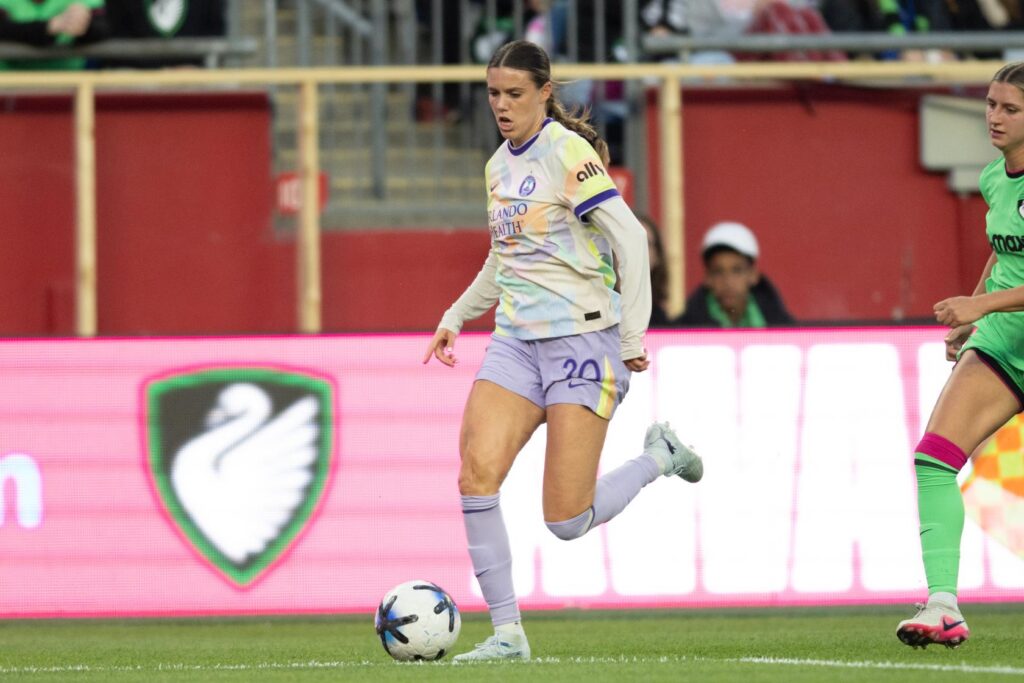
Doyle was Orlando’s third selection in the first round (No. 11 overall) in the 2022 NWSL Draft. The Santa Clara product signed her first pro contract on Jan. 27, 2022, through that season with an option year for 2023, which the club exercised in November following her rookie season. Doyle then signed a new two-year contract through the 2024 season on May 8, 2023. The Pride signed her to another new contract on Oct. 1, 2024, a two-year deal through the 2026 season, meaning she’s out of contract at the end of this year.
During her time in Orlando, Doyle has been a decent bench option and spot starter, but she hasn’t exactly broken out and has struggled to get into the starting lineup at times. Given her position, one might reasonably expect a former first-round pick to contribute more offensively, but Doyle has never exceeded two goals in league play in any season despite getting herself into some good scoring positions. Now 27, Doyle has shown the Pride who she is over the course of the last four-and-a-half seasons. It will be interesting if she’s shown enough to stick around on another new contract.
Luana — Midfielder
The first player we’ll discuss who has a contract option year after 2026 is the Brazilian international midfielder, who has battled back from a scary Hodgkins lymphoma diagnosis during her first year with the Pride in 2024. Luana signed with Orlando on Dec. 14, 2023, but played only a few games before showing up on the availability report as an excused absence. The Pride announced on April 29, 2024, that the Brazilian would miss the rest of the season to undergo treatment. She battled her illness while her teammates won the NWSL Shield and the NWSL Championship, inspired largely by her courage. Luana beat the disease, but it took a while to come back. She returned to the pitch in the second half of 2025 and did enough to earn herself a new contract, which she signed on Nov. 13, 2025. Her contract runs through this season but there is a mutual option year on the deal for 2027.
Luana has looked fantastic at times, and it’s easy to forget that she started the 2024 campaign as a starter for a team that went on to shatter club and league records en route to winning the double. She scored her first goal with the Pride in Orlando’s 2-0 home playoff win over the Seattle Reign on Nov. 7, 2025 (actually, it was her first goal contribution of any kind with Orlando). She was a big part of the buildup for the Pride’s winning goal at San Diego on May 24, although she did not get an assist because a defender touched the ball. Luana finally notched her first NWSL assist in the Pride’s most recent match — the 3-1 win on May 29, which sent the team into the break on a two-game winning streak. If her trajectory continues, it’s not hard to imagine her returning as a regular starter when all players are available, and she could once again play for the Brazilian Women’s National Team. On the other hand, at 33 years of age, time is not on her side in terms of her remaining career.
Marta — Midfielder/Forward
Look, at some point Marta has to retire, right? The 40-year-old legend has earned the right to go out on her own terms, but the two-year contract she signed on Jan. 9, 2025, seems likely to be her last. That contract concludes after this season, and this could be the Pride’s most important off-season decision.
Marta turned back the clock in 2024, playing at one of the highest levels of her illustrious career. That was an encouraging sign, and even though it would have been a storybook ending to a glorious career for the Brazilian icon to exit the world stage as a player after winning the double, Pride fans understandably celebrated her announcement that she signed a new contract with Orlando.
Her performances fell off in 2025 — something that plagued the entire team — but her availability in 2026 has been an even bigger issue. The Marta problem is that despite her age and lack of availability, she’s still hard to replace, because even in limited minutes, she’s performing better and helping the team win and retain possession more than most of her teammates and better than most potential replacements could do in her place. The goal production has tailed off, however, and that’s having an impact in the standings, because if Marta isn’t producing, the Pride have little offense outside of Banda (though Jacquie Ovalle’s return from injury should help).
The Pride would likely offer Marta a new one-year contract if she wants to keep playing. Few could blame them, and it’s hard to fault an athlete who loves the game so much that they don’t mind the diminishing returns they bring to their club as they extend their career. However, Orlando is in a transition phase, and using Marta’s salary elsewhere could help the club get younger, faster, and more threatening. Ultimately, this may be more Marta’s decision than Orlando’s, because the club will want Marta to end her career in purple. And while it seems the bell is tolling on a legendary career, it would surprise almost no one if she has another surge left in her.
Cara Martin — Goalkeeper
Pride fans could be forgiven for thinking Martin is an AI construct, because when have we seen proof of life? (OK, she’s made the substitutes’ bench a few times. Allegedly.) Martin signed Jan. 16 along with Castain and Nicole Payne. The former Big East Goalkeeper of the Year with Georgetown has not appeared for Orlando and her bio isn’t in the team’s game notes. Martin’s contract is up at the end of the season, and with Orlando collecting backup goalkeepers to work with the team in training and wait in line behind Moorhouse, the question is whether she’ll do enough to remain in the Pride’s stable of backup netminders.
Kylie Nadaner — Defender
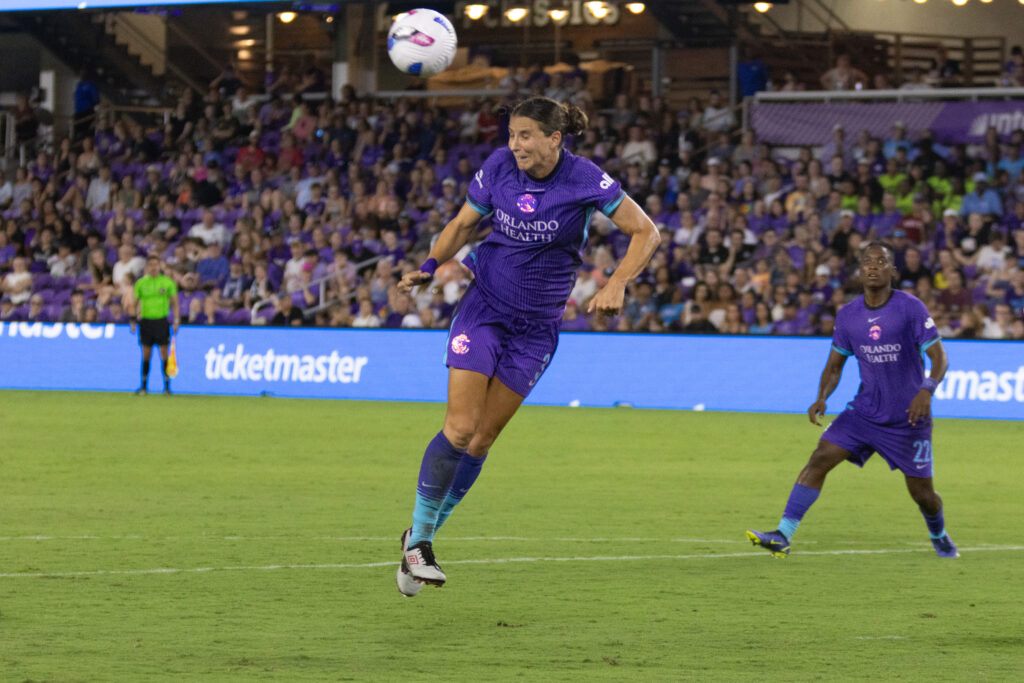
The club’s vice captain has been away on what has seemed more like eternity leave than maternity leave. Nadaner had her baby in May, and the long process of getting back into playing shape lies ahead. Meanwhile, she’s in the final season of a three-year deal she signed on Dec. 7, 2023. Nadaner began her time in Orlando as a struggling left back who worked her way into becoming one of the team’s most dependable center backs.
Nadaner will be 35 early next season as her birthday is in March. While it’s difficult for players to return to playing shape after giving birth to a brand-new human, doing it in your mid-30s is even tougher, though it’s doable. Whether Nadaner is offered a new contract may depend on her ability to get back on the field in the second half of 2026 and show she can still perform.
Oihane – Defender
The Spanish fullback is in the last guaranteed season of a two-year deal she signed on Feb. 14, 2025. However, that contract includes a 2027 option year. Oihane has looked strong at times, although some minor knocks here and there have disrupted her continuity. She’s been one of the team’s better crossers in open play, posting three assists in just under a year and a half with Orlando.
The problem for Oihane is she’s in the Pride’s deepest position group. Cori Dyke, Hailie Mace, Haley McCutcheon, Nicole Payne, and Reagan Raabe can all play right back. Oihane has also filled in at left back, but there is coverage there, too. We may not know until the postseason roster decisions whether the Spanish international will remain in the club’s plans.
Nicole Payne — Defender/Winger
A former Portland Thorns and (briefly) Paris Saint-Germain player, Payne signed a one-year contract with the Pride on Jan. 16 that expires after the season. She showed off her pace playing right back in her first appearance with Orlando, but she’s since seen time at right wing, scoring a big goal in a solid outing at San Diego in the final week before the break. She didn’t back up that performance well five days later against Bay FC, but you can see there’s talent, speed, and potential scoring punch from the USC product.
Whether Payne is brought back is likely still up in the air, but there has been some promise, and her potential has not been questioned. Staying healthy has been a challenge for Payne. If she can stay fit, she would at least make a good depth option if she can turn in consistent performances like the one she had against the Wave.
Reagan Raabe — Forward/Defender
Raabe arrived as a non-roster invitee in preseason camp and earned a short-term contract on March 5. She’s made a couple of appearances off the bench in different positions but hasn’t been able to show a lot in her limited action. Will it be enough for the 24-year-old Nebraska product to earn a fulltime contract? We’ll find out soon.
Viviana Villacorta — Midfielder
The Orlando Pride had high hopes for Villacorta after drafting her at No. 9 overall in the first round of the 2021 NWSL Draft. And while she’s shown flashes of the potential she had coming out of UCLA throughout her time in Orlando, injuries have plagued her career and have completely derailed multiple seasons. Even in 2026, Villacorta has been on the club’s availability list, most recently with a knee injury. She’s done enough to hang around and earn three different contracts with the Pride, who exercised her 2026 option on June 30, 2025, meaning she’ll be out of contract again at the end of the year.
Whether the club still values Villacorta as a good depth option or is ready to turn the page on the 27-year-old — or whether Villacorta even wants to continue her career — is a decision we’ll have to wait to find out.
Summer Yates — Midfielder
Yates was a highly regarded prospect out of the University of Washington who somehow fell to Orlando in the fourth round (No. 39 overall) in the 2023 NWSL Draft. She quickly earned a rookie contract on March 7, 2023, through 2024 with an option year for 2025. She played so well during the club’s 2024 run to the double that she earned a new contract on July 11, 2024, through 2025 with an option year for 2026. Unfortunately, Yates followed many other Pride players in regressing in 2025, but Orlando and Yates had already mutually exercised her 2026 option year in October of 2024. That means she’s out of contract after this season, like so many others.
The 25-year-old native of Pasco, Washington, is just entering her prime years, but her play since the start of 2025 has not shown many signs of the improvements we saw in 2024. Former general manager Haley Carter touted her off-season work on our podcast prior to the club’s 2024 double-winning campaign. Since then, Yates has not scored a league goal and has tallied only two assists in the regular season, although she notably notched a hat trick in a 5-0 win at Chorrillo FC in Panama a year ago. Her most recent game against Bay FC saw Yates thread the needle to set up Banda’s second goal of the night, which turned out to be the game-winner.
Yates does so many things well, but putting together consistent performances has been a struggle since the start of 2025. Some of that has been related to playing through some minor knocks. Every dribble into a blind alley or misplaced pass in the attacking third seems worthwhile when Yates sticks a gorgeous through ball into Banda’s path, but a return to her 2024 form, in which she scored five NWSL goals, would be her best path to a lucrative new deal with the Pride.
The Pride roster provides a lot of flexibility for Carducci. There are as many as 14 expiring contracts either, outright or with an option decision, and the competition for new deals will be stiff. Carducci can spend the rest of the 2026 season evaluating the squad, looking at the areas she wants to improve, and making informed choices about which players to re-sign and which to let go.
That, of course, is a double-edged sword, because letting things go too long can result in players becoming free agents and leaving for free. In the past, the Pride under Carter liked to lock players down before their deals expired. This year, we may yet see some signings before season’s end, but Carducci has the opportunity to overhaul the roster. At the very least, the bottom of the roster can (and should) be churned a bit.


Lion Links: 6/22/26

Orlando City B vs. Philadelphia Union II: Final Score 2-1 as OCB’s Four-Game Winning Streak Ends

Flashback Friday: June 18, 2022 vs. Houston Dynamo


-
 Orlando City2 weeks ago
Orlando City Taking Risk with No Immediate Plan to Hire New Head Coach
-

 Orlando City B2 weeks ago
MLS NEXT Pro Is a Development League and OCB Is Developing Some Winners
-
 Lion Links2 weeks ago
Lion Links: 6/8/26
-
 Orlando City1 week ago
Flashback Friday: June 10, 2023 vs. Colorado Rapids
-

 Lion Links2 weeks ago
Lion Links: 6/9/26
-

 Lion Links2 weeks ago
Lion Links: 6/10/26
-
 Lion Links2 weeks ago
Lion Links: 6/11/26
-

 Orlando Pride2 weeks ago
Orlando Pride So Far in 2026: The Good, the Bad, and the Ugly